Up until this point, my figure skating blog posts have focused on the beginning of my skating journey, that is, when I began skating decades ago. After careful thought, I decided I would take a break from writing about the past and jump ahead to the present. Some memorable events and moments have occurred recently in my skating that I would like to share. In this blog post, I report on the Janet Champion Spin Clinic I attended one weekend in the fall of 2022.
In terms of instruction in figure skating, figure skaters have one or more permanent coaches with whom they work on a consistent basis, week after week and in some cases day after day. However, from time to time clinics or master classes are offered by top coaches and other greats in the world of figure skating, presenting an opportunity for skaters to learn about the elements they are working on from a fresh perspective and innovative point of view. I had the opportunity recently to attend such a clinic on the art of spinning led by world-renowned figure skating coach and former elite skater and ice show performer Janet Champion.

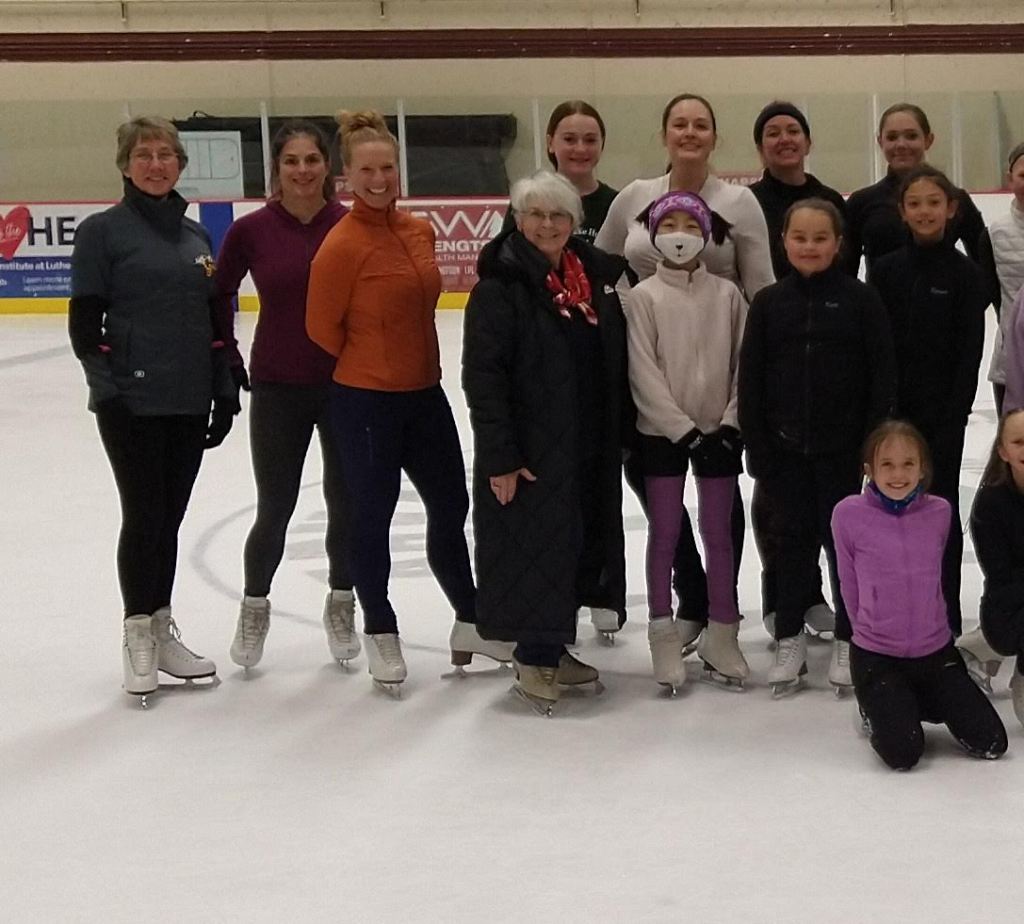
The above photo is of Janet Champion and the clinic attendees. Janet Champion is standing in the long black coat and red scarf on the left at the beginning of the second row. There were around 40 attendees, ranging in age from six to the sixties. Twelve of the attendees were adults. The irony of this experience is that I was initially hesitant to attend the clinic, thinking I would be the oldest skater there and that my aging spins would be the least spectacular in the bunch. I almost did not go. In reality, I fit right in! I cannot believe I almost let fear deter me from what ended up being an energizing and restorative experience for my skating.
It is essential to take advantage of opportunities like Janet Champion’s spin clinic to challenge ourselves and help hit the reset button. The day-to-day practice routine can put a skater in a stupor without them realizing it. For example, skaters can fall into a pattern of spending most of their time focusing on the elements they are comfortable with, and skip or put off practicing the elements that need work. Even worse, a skater may be reluctant to attempt certain elements because they are paralyzed by the thought – however misguided it is – that they will never be able to achieve them. And for those of us older adult skaters, we may fall into the trap of thinking we will never be able to perform an element as well as we did when we were younger, so why even try?
I did not realize until I attended the clinic that I had indeed fallen into such a stupor. For me personally, the clinic was an energizing jolt that woke me up and forced me to remember what I am capable of on the ice. This acknowledgement has made me more confident to attempt the elements I thought I could no longer do. Perhaps the key takeaway from the clinic for me was a challenge to prevent limiting thoughts from inhibiting my skating. Rather than assuming I will never again be able to perform certain elements because of my age (and the physical pain that often accompanies it), I will retrain my brain to believe that I can do it if I try. After all, at the clinic I attempted a flying sit spin for the first time in 24 years! Before I went to the clinic, it never would have entered my mind to attempt a flying sit spin again… I had tacitly accepted that such spins were a part of my past and no longer in my repertoire.
Now I will discuss the workings of the clinic itself. The clinic began with an off-ice presentation on proper spin technique. Janet illustrated her presentation with photos and videos of elite and soon to be elite skaters practicing spins at the world-renowned Broadmoor Skating Club. It was humbling to see the skaters effortlessly perform challenging spin combinations and positions. Janet used the photos and videos to demonstrate desired technique (who knew that a slight adjustment to the position of the head could make or break a spin!) and, on rare occasions, what we should not do. It was somewhat of a relief to see that there is always room for improvement, even among elite skaters!
After the off-ice presentation we spent three hours on the ice practicing, you guessed it, spins! Janet would hold an on-ice discussion about a specific spin and then we would practice just that spin for about twenty minutes, while she skated around the ice observing us individually and giving us tips. Janet gave me some great tips on the layback spin, suggesting a new position for the arms. I had been reaching my arms up and above my head the moment I would begin bending my back backwards into the layback position. Janet said that when she teaches the layback spin, she has her students hold the arms in front of the body, not above it, until the layback position (the position of the back) is secure. She further honed the position of the arms by suggesting I reach my right arm across my body to the left, while holding my left arm to the left and a little bit behind. This helped distribute my weight more equally on both sides of my body. When I tried Janet’s suggested position, my layback position felt more secure, and I was able to spin faster. And perhaps most rewarding of all, Janet remarked that the spin looked very nice!
In addition to the layback spin, we worked on the forward upright spin, the backward upright spin, the camel spin, and finally, the camel and sit flying spins. The energy was invigorating and palpable, forty skaters spinning on the ice at the same time! While I consider myself an internally motivated person, I must admit I fed off the energy. It helped me push myself. Most importantly, the energy took me out of my head and into the present. The annoying thoughts that normally inhibit my practice were not clouding my mind. I was not thinking as I stepped into a spin that it might not be strong, and I was not focused on the pain in my lower back. I was just spinning!
Another key takeaway from the clinic was an innovative approach to how we practice spins. Often when we practice, we do not tend to work on the same element over and over. Instead, we may practice each of our spins a couple times, and then move on to jumps, and then work on our footwork. At this clinic, however, we practiced each spin over and over again, for up to twenty minutes at a time. Practicing in this manner allowed us to experience incremental, nuanced progressions in our spin technique as time passed. For example, my spin entries became stronger the more I practiced the same spin. I noticed my knee bend getting deeper and experienced an improvement in edge quality when I stepped into the spin. I gradually found myself stepping onto the desired outside edge of the blade when I entered the spin, as opposed to the flat of the blade. As a result, my spins became more secure and centered and I was able to spin faster. This innovative approach of intently focusing on just one spin for an extended length of time is one I will attempt to integrate into my practice moving forward. It helped me to understand that while our habit of quickly running through every spin we can already perform helps maintain the status quo, practicing one spin in depth allows us to experience nuanced and incremental improvements that add up over time, ultimately propelling us forward in giant leaps.
The clinic concluded with Janet’s elite skater assistant, a young man named Josh, teaching us what is called the “Champion’s Lap.” In testament to how busy and sought after Janet is as a coach in the world of competitive figure skating, she had to depart the clinic early to catch a flight to Michigan for the Midwestern Sectionals competition. Contrary to what one might think, the Champion’s Lap nomenclature is not in reference to Janet Champion. Instead, from what I understand, it derives its name from its purpose as a lap pattern skated by the champions of competitions when they greet and wave to the audience after receiving their medals. The pattern, consisting of forward and backward crossovers, mohawk turns, and wide, gliding steps, was fun to skate and offered a new option for warming up at the start of a practice session. I found the Champion’s Lap to be so fun, energizing and useful that I will dedicate a separate blog post to it. I’ll do a deep dive into the Champion’s Lap in my next figure skating blog post.
I left the Janet Champion Spin Clinic infused with positive energy from which to approach my figure skating. The clinic was so energizing, in fact, that I was in an elevated mood for the next two weeks! In addition to learning an innovative way to practice spins, I became enlightened to the reality of how negative thoughts and tacit acceptance of my perceived incapability were inhibiting my skating. I left the clinic with a newfound determination and will to step outside my comfort zone, to stop using my age as an excuse to give up on the more challenging elements I was working on decades ago. Rather than being encumbered by thoughts of what is not possible, I departed the clinic energized by the thought of what is possible, enthusiastically looking forward to what is yet to be.
Thank you to the Alpine Skating Club for hosting the Janet Champion Spin Clinic! It was a privilege to learn from Janet Champion, an accomplished and cherished personality in the world of figure skating. And thank you to Janet for taking time out of her busy schedule to work with us!
The above photo is a close-up of Janet Champion, who can be seen in the middle in the long black coat and red scarf. Five of the adult skater attendees are also pictured, including my friend Ruth at the far left in the back row. Ruth is such an inspiration, continuing to train and compete in her sixties. I am in the back row in the cream-colored top. And an interesting note on Janet’s skates… if you look closely, you will notice they are not white, but a pearly silver color. Oftentimes figure skating coaches will have fun with the look of their skates, opting for custom colors and textures beyond the standard white, black, or tan leather. I have seen everything from Janet’s pearly silver skates to bright red to a turquoise-colored suede, and even the American flag. My own perception of this liberty taken by coaches is that it may be a way of announcing to everyone, “hey, I made it, I accomplished all my skating goals!” Or maybe it is simply because they are no longer limited by the constraints of competing and want to do something unique and out of the ordinary.

This last photo is a fun, dare I say even artful shot of the clinic attendees’ on-ice necessities, stored in an orderly and accessible manner along the wall of the rink. Among other items, several bright and colorful Kami So brand and Adults Skate Too brand ice skating totes can be seen. The totes are popular because they allow for all of our on-ice accoutrements to be stored in one place, for example, our Kleenex, gloves, water bottles, blade guards, hair ties, cell phones, note pads for recording our progress, and more.
Please subscribe to my blog by entering your email address below. It is an honor for me to share my experiences with you!
 Finding Balance on the Edge: Figure Skating & Travel Journeys by Carolyn Tir