
I sustained a high-grade tear to the MCL on my left knee this past summer. While initially it was devastating – requiring me to take a three-month break from figure skating – I worked hard to find a silver lining. I discovered two off-ice exercises on my road to recovery that not only helped maintain my fitness level while my usual exercise routine was interrupted, but also helped improve my figure skating once I was able to return to the ice. In fact, the exercises were so useful that I have incorporated them permanently into my off-ice training routine. And while in this post discussion of the exercises is oriented toward figure skating, any athlete recovering from an MCL tear can incorporate them into their recovery. The exercises were recommended by my orthopedist for MCL recovery in general, after which I refined them to apply to the sport of figure skating more specifically.
The MCL, or Medial Collateral Ligament, is one of the knee’s four ligaments. Ligaments provide stability to the knee by holding together bones, joints, muscles, and tendons. When recovering from an injury to the MCL, exercise is paramount because it stimulates blood flow to the injured area, speeding up the healing process. Due to its location on the inner side of the knee, when the MCL is injured it is possible to perform exercises requiring a gentle up and down, non-pounding motion of the knee because the MCL is not engaged. By contrast, exercises requiring a side to side motion, for example, the frog kick when swimming, or those that cause pounding of the knee, for example, walking or running on a treadmill, should be avoided as they strain and engage the MCL.
My orthopedist recommended three different exercise options for my recovery: the stationary bike, the elliptical machine, and swimming. I initially tried the stationary bike but found it too boring and not burning many calories. So I moved on to the elliptical machine and swimming, both of which I found more interesting and could modify slightly to benefit my figure skating.
The elliptical machine is ideal for maintaining fitness while recovering from an MCL injury. The continuous ellipse-like motion prevents pounding of the joints and, because the knee is moving in a slight and gentle up and down manner, does not strain the MCL. The elliptical machine offers a variety of workout programs, ranging from fat burning and aerobic to strength training and climbing, allowing the user to select a workout based on their needs and fitness level. Perhaps the best benefit for figure skaters is that the workout provides an opportunity to build core strength, from which strong posture on the ice follows. I modified my workout in this aim by maintaining an upright, hands-free position on the elliptical as if I were running in place, making sure to avoid holding on to the machine’s handles. This position helps build core strength as the core muscles, which include the abdominals, obliques, and those surrounding the spine, must be engaged in order to maintain it. It is key to NOT hold on to the machine’s handles as doing so causes the upper body to lean forward and break at the waist, after which the core muscles are no longer engaged. In the below photo I demonstrate the upright, hands-free position necessary for engaging the core muscles and developing core strength. A bonus for figure skaters is that it should be easy to achieve the position due to their keen sense of balance, making this an ideal exercise for them.

However, one does not need to be a figure skater to achieve the hands-free position. It can be accomplished relatively easily by following a few basic tips. First and foremost, it is key that the hips, waist, torso, neck, and head sit stacked one on top of the other, creating a straight, vertical line. One tip to maintaining a vertical line is to keep the head and chin up at all times. I find that gazing slightly upward helps keep my head and chin upright, as I demonstrate below.
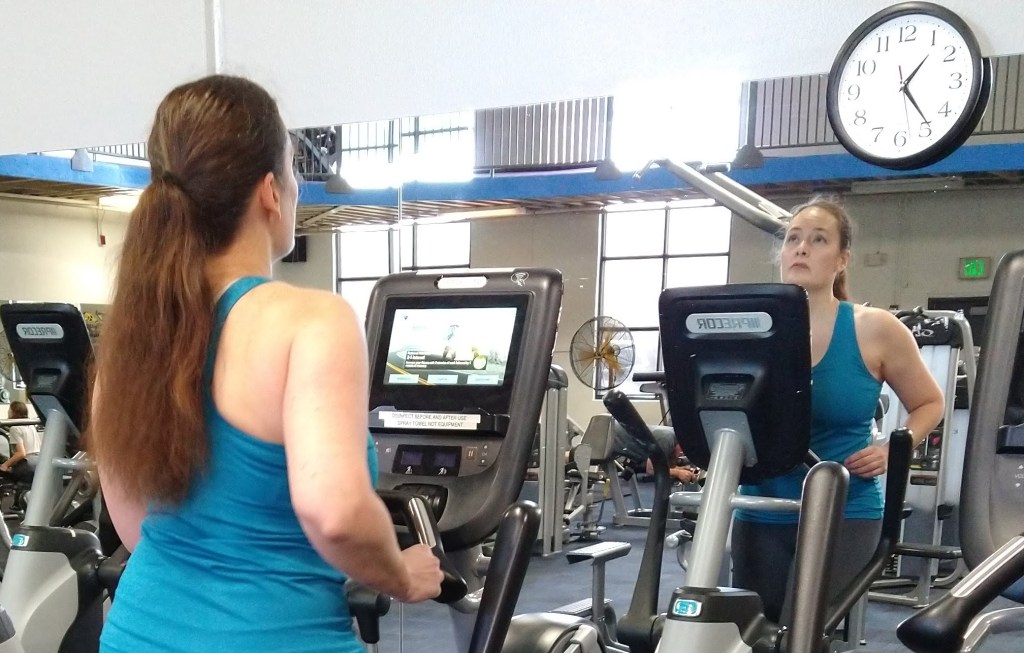
Another tip for maintaining proper position is to avoid the temptation to look at the screen on the elliptical machine, as doing so causes the head and chin to drop down, which disturbs the vertical line and throws off the position. If a little media is needed to keep motivated throughout the workout, try focusing on the music being played in the gym instead. Perhaps one of the best tips of all for maintaining proper position is to be mindful and intentional throughout the workout by actively thinking about tightening and engaging the core muscles. Doing so allows one to check and correct errors as they occur, ultimately resulting in a more focused and productive workout.
My exercise on the elliptical allowed for a seamless transition when I returned to the ice. After having been off the ice for three months, I was concerned that my posture would be weak, that I would lean forward too much when I skated. I was pleasantly surprised to discover that the opposite was true. My exercise on the elliptical not only helped maintain the proper core strength from which proper posture on the ice follows, it helped improve it. I discovered this immediately when I began stroking around the ice. I was able to naturally find and maintain a straight, vertical line from my hips to the top of my head with my head and chin held up, allowing me to generate greater power and stability with each stroke. This strong, upright posture was evident when I practiced three-turns as well, helping me to better control and hold the exit edge. I also felt an improvement when I started spinning. On my scratch and sit spins it was easier to center the spins due to the strong, upright posture. It was as if the body was in one distinct piece as opposed to a bunch of disparate elements. Stronger core strength also allowed me to spin a little faster because my body was tighter and more upright, allowing the rotation around the axis to occur more quickly. And on the camel spin, I was able to keep my head and chin up more consistently upon entering the spin, which is key to the spin happening in the first place. A common mistake on the camel spin is to drop the head upon entry, which makes it impossible to start the spin; the spin is over before it begins.
Now I will discuss how swimming is beneficial for MCL tear recovery. The buoyancy of water reduces the effects of gravity, making the body much lighter. This, combined with the fact that there is no pounding motion against a hard surface, allows for little to no stress on the knees. Now, certain swimming strokes are better for the torn MCL than others. For example, the crawl stroke, also known as freestyle, is ideal because the kick is a simple up and down motion originating in the hip joints. It is possible that the knees will bend a little bit, but because of the up and down motion the MCL is not engaged, making the crawl’s kick possible while injured. It is also possible to swim with a kick board and do the crawl’s kick by itself. This is what I did as it was easier to perform the kick accurately without engaging the arms and monitor any pain to the MCL. By contrast, strokes that engage the MCL, for example, those with the frog kick such as the breast stroke, should be avoided.
I soon discovered that the pool’s shallow end offered an ideal space for practicing figure skating jumps off-ice. The water’s buoyancy creates a cushion when one falls, unlike the hard and unforgiving surface of the ice. This safety net bred a confidence that allowed me to attempt, explore, and achieve the proper in-air jump position that has been more difficult to attain on the ice, where fear often gets in the way. I was reminded how the position of the core, shoulders, head, neck, and arms is supposed to feel when the body leaves the ice, allowing me to develop muscle memory. The goal now is to transfer the muscle memory developed in the pool to the ice. Please note I began practicing jumps in the water over a month into my recovery, after my MCL was well into the healing process. I wouldn’t have been able to do this exercise immediately after the injury. Also, when I practiced the jumps I was already in the water, starting from a standing position in the middle of the shallow end of the pool itself, far away from the wall of the pool. DO NOT jump into the pool from the outside!
The below photos demonstrate the improper jump position that skaters often cave to out of fear, and the proper jump position that we should aspire to and I was able to practice and experience in the pool.


For some reason, although the position on the left is incorrect and thus more dangerous, instinct tricks us into believing that curling the upper body into a pseudo fetal position is safer, with the shoulders rising up toward the ears and the head dropping down toward the chest. By contrast, the photo on the right demonstrates proper jump position, with the entire body in a straight, vertical line. The shoulders are pressed down and the head, neck and chin are held upright, pointing upward and away from the shoulders. This position results in the body soaring straight up when it leaves the ice, resulting in a more successful jump and less risk of falling. I was able to achieve this position over and over in the pool because I was unafraid of falling. It was a liberating feeling. Unfortunately, so far I have been unable to replicate the position on the ice (I’ve only skated seven times since my MCL tear and have some fear around certain jumps). But, now that off-ice pool practice has reignited my muscle memory of proper jump position, in time I will get there once again.
I’ll end this post by sharing how I tore my MCL. Ironically, my injury did not occur on the ice, but when I was riding my gravel bike. I had been going on two 90-minute bike rides per week as part of my off-ice training routine, as cycling is easy on the body’s joints and provides a great aerobic workout. The injury occurred when I fell off my bike riding downhill through a series of switchbacks on a paved path. I ride through these switchbacks every time I ride my bike, so was surprised that I fell there. My bike must have slid on sand or scree. It was as if the bike just slid out from under me to the right, almost in slow motion. The fall caused my left knee to turn inward, with the bike then dragging my leg and knee – which were bent in a ninety-degree angle – across the pavement. Following the injury I underwent X-rays and an MRI, after which it was discovered that my MCL was torn most of the way through. My orthopedist did not recommend surgery, saying that the MCL heals the easiest of all the knee’s ligaments, in particular if you are in good health and dedicated to regularly performing the recommended recovery exercises. My orthopedist predicted that I would be back on the ice in three months. When I initially heard this I was in disbelief given the pain I was in, but in three month’s time I was back on the ice, just as she predicted.
Thank you to my husband Jaroslav and friend Carol for taking the photos of me on the elliptical and ice, respectively.
If you’ve enjoyed what you’ve read, subscribe to my blog by entering your email address below. It is an honor to share my experiences with you!
 Finding Balance on the Edge: Figure Skating & Travel Journeys by Carolyn Tir