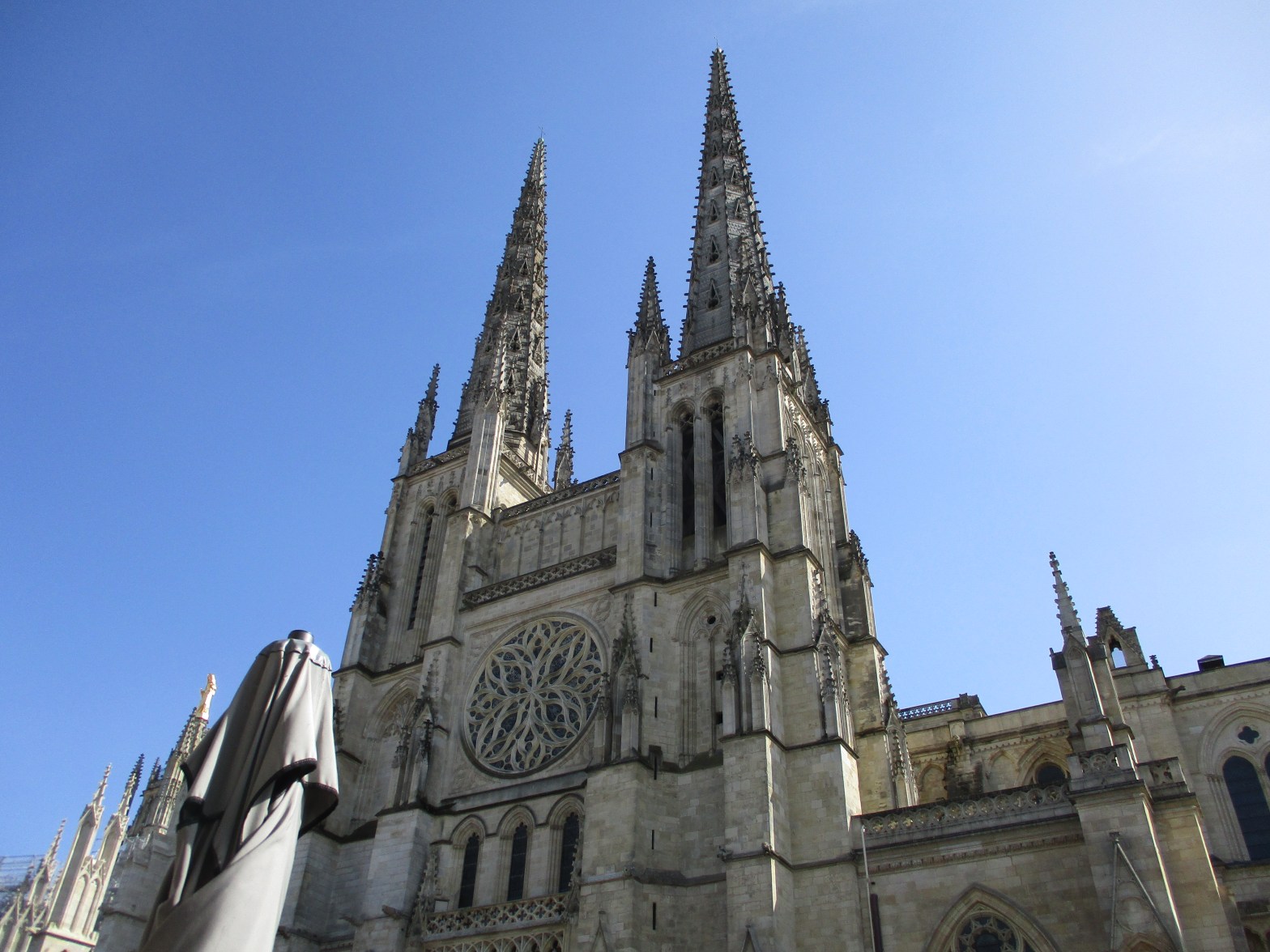
In this post, I explore the Cathédrale Saint-André de Bordeaux and what I view as the paradox of cathedrals. That is, how cathedrals serve as embodiments of eternal life yet at the same time force us to face the brevity of life. This post is the second in a three-part series about a day I spent wandering in Bordeaux, France.
Image featured above: the north side of the Cathédrale Saint-André, including the gilded adornment of the Tour Pey-Berland (far left) and the rose window, set brilliantly against a clear blue sky.

While I will not recount the complete history of the Cathédrale Saint-André, I will highlight the historical elements I found most fascinating. The cathedral is a UNESCO World Heritage Site. Its construction spanned five centuries, from the eleventh through the sixteenth. In the twelfth century, it was the site of the wedding of Eleanor of Aquitaine and the future French king Louis VII. And in the early seventeenth century, the parents of future French king Louis XIV were married there. While most of the original stained glass in its windows no longer remains, the rose window on the north side of the cathedral is scattered with pieces of glass from the cathedral’s medieval beginnings.

I was able to marvel at the cathedral’s exterior from my table at a sidewalk café on the Place Pey-Berland, directly across from the cathedral’s north side. After finishing my coffee, I ventured inside the cathedral to explore its interior.

Now, for a more philosophical discussion of Europe’s cathedrals, within the context of my visit to the Cathédrale Saint-André. I’ve always made it a priority to visit the cathedrals in every city I visit. Not only are they stunning architectural wonders, they provide a quiet place to sit, rest a bit, and consider next steps.

Perhaps most of all, cathedrals offer an opportunity to face and contemplate the brevity of life, how our lives are but brief points along a greater continuum. For when one considers how old the cathedrals are and just how many generations of people have contemplated within their walls, it puts our time on Earth in perspective. After our lives are over, the cathedrals will still be standing, welcoming new generations, just as they have welcomed dozens of generations before ours. Our generation’s duty, like that of past generations, is to tend, maintain, and preserve the cathedrals for future generations, who will one day inherit and assume the same duty. We are but mere caretakers at one point in time.
This leads me to ponder what I view as the paradox of cathedrals: they offer an opportunity to contemplate the brevity of life in a setting that celebrates eternal life, life that endures forever and never dies. Through the grandeur of their design, the longevity of their existence, and the word delivered by their clergy, cathedrals celebrate and serve as timeless, tangible symbols of eternal life. Yet when I visit a cathedral, surrounded by pieces of stone that have been in place for centuries, I’m forced to face the unsettling reality of how fleeting and insignificant my own existence is. And in that moment – given my own questions and doubts about the concept of eternal life – facing that reality leaves me feeling uncomfortable and and a little depressed.
After all of that intense contemplating, I decided to wrest myself out of my head by wandering around the cathedral’s interior. While doing so, I was pleased to discover an uplifting sentiment of Saint François de Sales mounted to the wall of the cathedral. When translated to English, it reads “All through love, nothing through force.” If only the world would take this advice to heart! In keeping with the timeless and enduring nature of cathedrals and the message conveyed by their clergy, the sentiment is as relevant in the twenty-first century as it was during Saint François de Sales’ life in the mid-sixteenth to early-seventeenth centuries.

I’m always interested in checking out the organs in cathedrals, as my father is an organist (and pianist and cellist). I stopped to take in the organ’s massive pipes above the rear of the nave. This current organ was installed in 1982. It conjured up happy memories of attending an organ concert in another of France’s great cathedrals, Notre Dame de Paris, with my parents in 1994.

While wandering across the cathedral’s transept, I snapped a photo of the vaults in the ceiling above the choir area. The vaults were added in the sixteenth century, during the fifth and final century of the cathedral’s construction. It is so fascinating to consider that even though it took five-hundred years to complete construction, it has been five-hundred years since construction was completed. Yet another mind-boggling example of the brevity of life cathedrals make us face!

Finally, religion is so serious it can be fun to find humor in it from time to time. I found just that in the below ad inside the cathedral. A handsome priest is advertising an app to make the act of tithing more convenient. Don’t have any cash? Use the collection app! I find the irony quite entertaining, that a place of worship would use physical attraction to manipulate the faithful to tithe! And also that an institution as old as the Catholic Church would readily embrace modern technology to generate income.

And on that hilarious note, I departed the cathedral and continued along my wandering route. The third and final post about my wanderings should appear within a few weeks. I’ll share about the terminus of my route, the Place de la Comédie, as well as the late-afternoon snack I had there at Le Regent Café.
If you’ve enjoyed what you’ve read, subscribe to my blog by entering your email address below. It is an honor to share my experiences with you!
 Finding Balance on the Edge: Figure Skating & Travel Journeys by Carolyn Tir
Very interesting, Carolyn. Good insights. Love, Mom
LikeLiked by 1 person
I do sometimes come out of them (cathedrals) with an image of Christ turning over the tables outside. You never see a poor looking priest and the glitter is sometimes excessive. I felt a little that way at the ruckus on the steps of the cathedral in Cadiz. It’s the puritan in me, but I can laugh at myself. The architecture astounds.
LikeLiked by 2 people
Excellent insights! The opulence is indeed in conflict with what Christ taught. I, too, grew up in a puritanical-type faith so it is very different. Although beautiful architecture to marvel at.
LikeLiked by 1 person