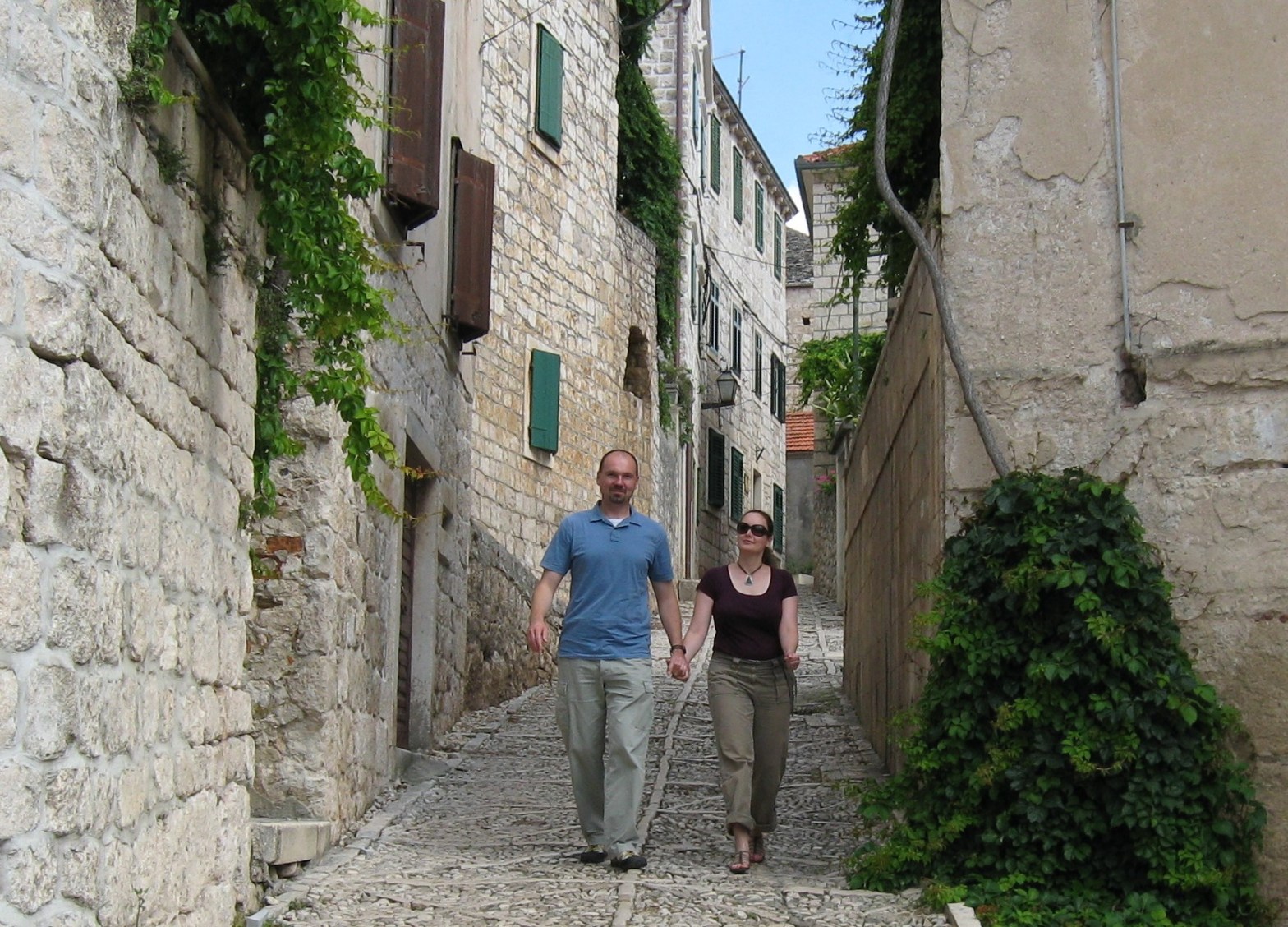
The stroll, or “šetnja” in Croatian, is a beloved pastime in Croatia’s coastal Dalmatia region. In this post, I explain why the šetnja is so popular in Dalmatia. Then, I explore the tradition specific to the after-dinner hours, set against the backdrop of my family’s travels on the Dalmatian island of Vis.
Image featured above: My husband Jaroslav and I taking a stroll on the Dalmatian island of Brač.
The šetnja (pronounced sheht-nee-yuh in English) is an essential part of daily life in Dalmatia for a variety of reasons. The region’s Mediterranean climate is mild and dry, making life outdoors possible all year long. The stunning location of the region, situated along the coast of the Adriatic Sea with the Dinaric Alps mountain range rising up to dramatic heights in the background, permits for amazing views perfect for strolling. Perhaps most importantly, due to the high population density and cost of living in most coastal cities and towns – there simply isn’t much building space between the sea and the mountains – people tend to live in smaller and restricted spaces, leading them to venture out beyond the confines of their homes. In fact, when I think about living spaces in the Dalmatia region, I see the town as the living room and the actual physical dwelling itself more for sleeping and storing possessions.


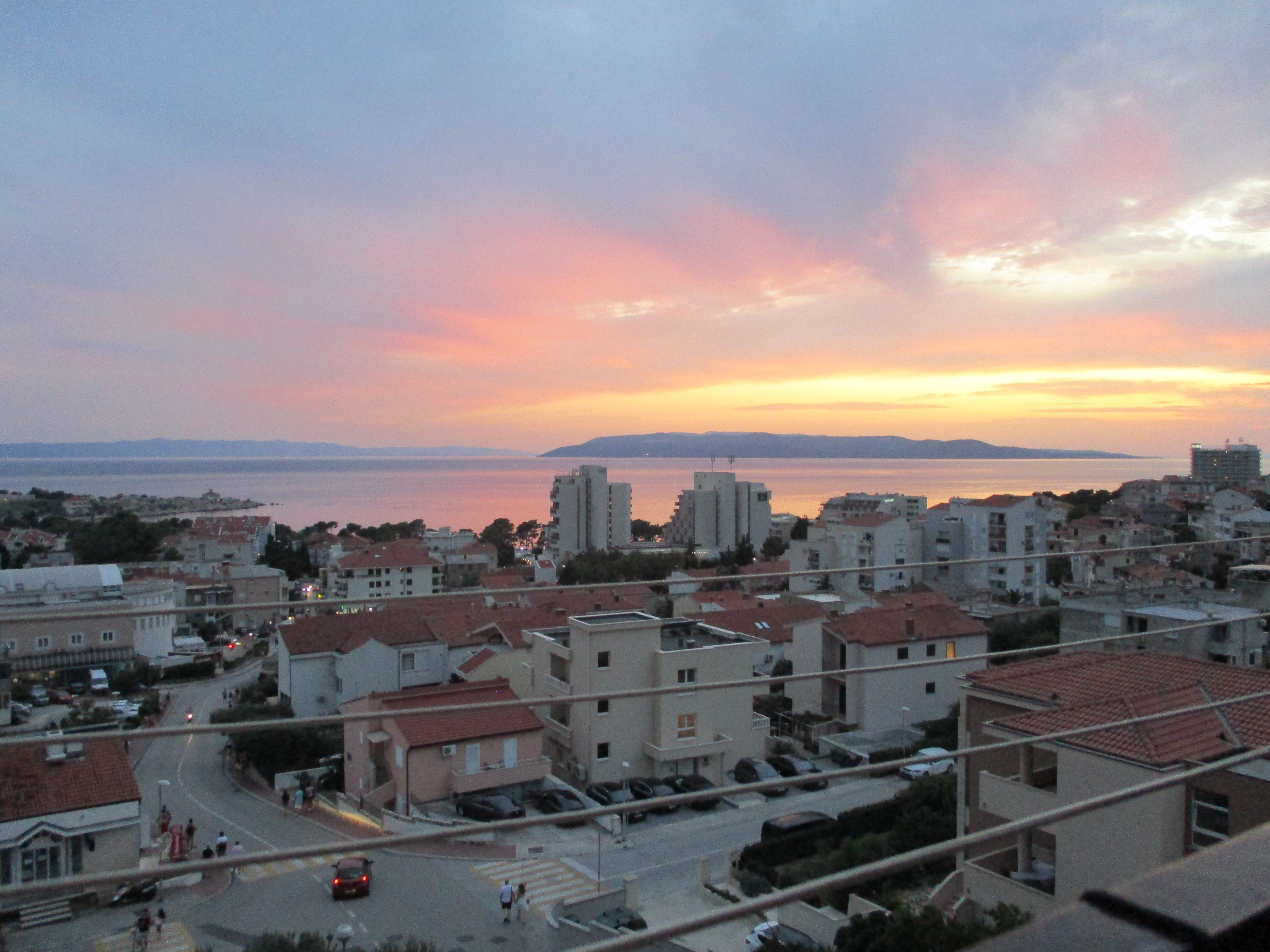

The above photos demonstrate the smaller living spaces characteristic of many Dalmatian homes, leading residents to find balance by partaking in outdoor activities such as strolling. Clockwise, from left to right: 1) The Makarska apartment building where my husband and his sister grew up and where his sister now lives with her family. 2) The living room of the Makarska apartment, which is just 650 square feet and has two tiny bedrooms, one bathroom, a kitchen, a living room, and a balcony. Bedding can be seen folded up on the sofa, where Jaroslav and I sleep when we visit. Somehow we make it work, even with four adults and two children sharing the small space. Spending time outdoors each day helps us all maintain our sanity in tight quarters! 3) The stunning view from the balcony of the apartment, at sunset and just before we left for our after-dinner stroll. The Adriatic Sea and the islands of Brač and Hvar can be seen in the distance. The expansive view adds depth and dimension to the small space (and beckons us to go on a stroll!). 4) My husband and our niece putting a puzzle together in the living room during the heat of a summer afternoon, when we tend to remain indoors if we don’t go to the beach. In the summer the heat of the day makes a stroll in the after-dinner hours all the more essential and special, as the temperature has finally dropped just enough to venture outdoors.
The šetnja tradition follows us when we travel to the island of Vis, where it is a cherished part of our evening dining ritual. When we’re on Vis we stay in Komiža, a picturesque town composed of quaint alleys and pedestrian-only streets, built centuries before the automobile and nestled along a horseshoe-shaped harbor leading out into the Adriatic Sea. The pedestrian-friendly nature of Komiža ensures that all can take part in the beloved Dalmatian dining tradition of the after-dinner stroll.


The above three photos capture the stroll-inducing nature of Komiža. Clockwise from left: 1) Ribarska Ulica, or “Fisherman’s Street” in English, the main pedestrian thoroughfare through the town. 2) Gusarica Beach, where Ribarska Ulica begins. 3) The busy pedestrian intersection where Ribarska Ulica meets Komiža’s “riva,” the Dalmatian word for a walkway along a harbor front. The intersection is full of people out and about, enjoying the evening.
The full expanse of Komiža’s riva can be seen in the photo below. The riva is a quintessential part of the built environment in Dalmatian towns. In fact, I can’t think of a single town in the region without one. It’s as if the riva was devised with the premise that residents would spend lots of time outdoors, helping solidify the stroll as an essential part of life in the region. A popular strolling route in Komiža is from the start of Ribarska Ulica by Gusarica Beach to the end of the riva just beyond the Venetian fortress, which can be seen at the far right in the photo below. The stroll takes around thirty minutes at a leisurely pace. But of course there are many beautiful views, delightful little shops, and inviting cafés to distract you along the way!


The above photo on the left (Jaroslav’s sister, me, and Jaroslav) was taken after we finished dinner at Pizza&PastaFabrika, before setting out on our after-dinner stroll. Pizza&PastaFabrika is located next to perhaps one of the greatest architectural wonders of an after dinner stroll in Komiža, the Venetian fortress (above on the right). The fortress takes on a completely new aura at night. Its karst limestone façade is bathed in light, creating a stark contrast to the night sky. The contrast gives the fortress a more imposing presence than during the daylight hours.


Perhaps the greatest highlight of an after-dinner stroll is the opportunity to get to know family better. This is of particular importance to us because we only see our family in Croatia once per year. The above two photos are of Jaroslav and me getting to know our three-and-a-half-year-old nephew. The three of us can be seen from behind in the photo on the left, strolling past the Venetian fortress. In the photo on the right, Jaroslav and our nephew are making their way just beyond the fortress onto the pier, where nautical tourists dock their sailboats and yachts for the night. On this particular night, our nephew was expounding on how he dislikes it when his father leaves him each day to go to work. It was adorable and such a happy memory!

Part of the thrill of the after-dinner stroll is that you can never really predict what you might encounter. On the above evening, we came across a Komiža resident walking his donkey in the street just behind the riva. Our niece had a lot of fun petting the donkey. The donkey is perhaps the most common pack animal in Dalmatia. It is often featured on the labels of wines from Vinarija Dingač, a popular winery in the region.

An after-dinner stroll in Komiža is not complete without taking in the nautical ambiance of the area. Above, Jaroslav and I are doing just that on the riva. Below are sailboats anchored in Komiža’s harbor at sunset.

And below are the sailboats anchored in the harbor after dark, with only the tiny lights at the top of their masts visible. Sailboats not anchored at a dock are required to have a light at the top of their masts so their location is visible in the darkness. It’s a romantic sight, all the little lights bobbing on the sea against the backdrop of a dark and starry night.
A goal of all of our after-dinner strolls is dessert. Ahem, may I introduce you to THE CREPE LADY! as our family affectionately refers to her. The crepe lady’s cute little crepe stand is located on the riva in the town of Vis and is open each summer night (she’s closed during the day) into the wee hours. It is a tradition of ours when we stay in Komiža to make the short drive over the hill to the town of Vis at least once to devour her delicious crepes. We then stroll along the Vis riva, crepes in hand.


Above is the crepe lady in action. We still haven’t figured out what her business is called, but it is virtually impossible to misunderstand its purpose. Her stand has the word “crepes” spelled out in multiple languages. The crepe lady greets her customers with her characteristic steely gaze, barely cracking a smile. Some tourists may find that off-putting, but I appreciate her honest and real demeanor. For I come from the USA where we are taught to smile no matter how we are feeling, even when we are feeling down. I find the pressure to put on a happy face emotionally draining, so find the honest demeanor of the crepe lady – and in fact the Croatian people more generally – a refreshing relief.
Some nights Jaroslav and I extend our after-dinner stroll by adding drinks to the mix, even after dessert. Below is a photo of the delicious Aperol Spritz I ordered one night at Karoca Gre, a happening café along the riva in Komiža. I like that it was served with a compostable straw, keeping the natural beauty of the island in mind.

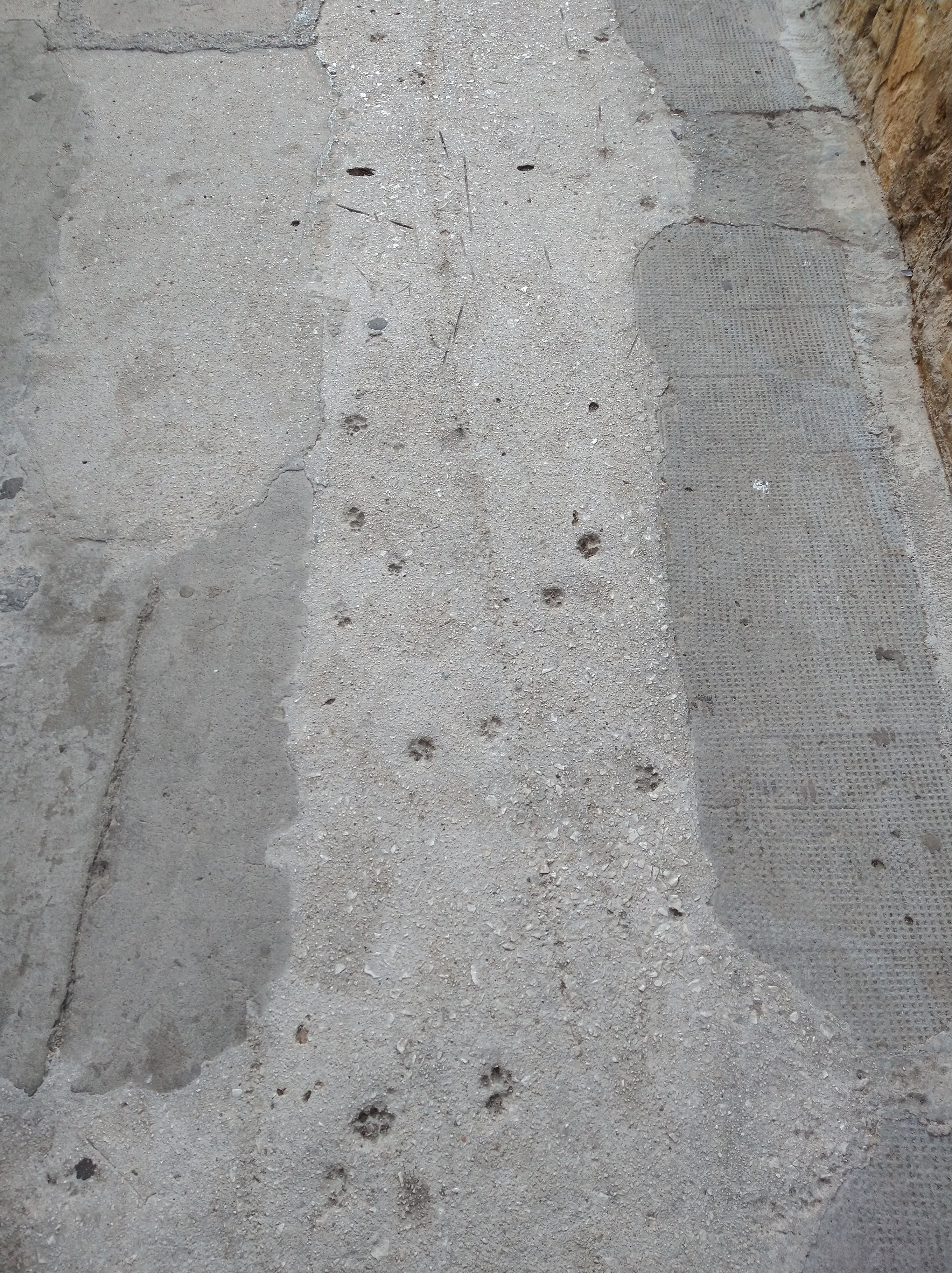
I will end this post with a shout-out to our four-legged friends, who appear to enjoy strolling in Komiža as much as humans do! Below two photos: a couple kitties hanging out in an alley off Ribarska Ulica, and kitty paw prints in a stretch of pavement on Ribarska Ulica.

If you’ve enjoyed what you’ve read, subscribe to my blog by entering your email address below. It is an honor to share my experiences with you!
 Finding Balance on the Edge: Figure Skating & Travel Journeys by Carolyn Tir
A tradition I particularly love about southern European living. The Riva in Split is one of my favourite places to be of an evening. Viz is high on my list of places to visit…
LikeLiked by 1 person
The Split Riva has great energy! I love all the cafes, one after the other. And thank you so much for following my blog! That means a lot.
LikeLiked by 2 people
How enchanting! I can see why you love it. I would love to visit Croatia again.
Love, Mom
LikeLike
What a lovely read, Carolyn! Do you speak Croatian, or do you communicate with your family in English? I was already in my mid 50s when Dad was reunited with his Polish family. I did start to learn the language but we had just acquired a holiday home in Portugal and I found the conflict between the two quite difficult. Although I’m looking forward to seeing them tomorrow I do wish I could speak Polish. I have a string of words but putting them together is not so easy.
LikeLiked by 1 person
Thank you so much for your kind comment! All of the gen-Xers (and younger) in my family over there speak English so I speak English with them. I have tried to learn the language (it’s harder to do that as an adult!) and lived over there at one point for 6 months, so have had an opportunity to develop a basic grasp, although I am probably flattering myself! My late in-laws did not speak English so I did speak Croatian with them. Have a great time with your Polish family! I can relate to the challenge of putting words together. I have a good vocabulary, but then the words come out in the wrong order…
LikeLiked by 1 person
And when I need a Polish word, invariably a Portuguese one comes to the fore, and vice versa…
LikeLiked by 1 person
Yes! 🤣 The same thing happens to me with Croatian and English. I call it Cro-Glish.
LikeLiked by 1 person
I speak French so sometimes French words pop in there when I speak Croatian as well. It’s funny how when the brain is unaware of one word in a foreign language it reverts to the same word in a foreign language that it does know!
LikeLike
Some of my Polish did come back while we were talking today, but not much. By the time they go home I might be able to string 2 sentences together!
LikeLiked by 1 person
Good job 👍
LikeLiked by 1 person