
This post is the second in a two-part review of the Road to Gold Destination Vail 2023 adult figure skating camp. Held in Vail, Colorado, USA each summer, the camp features two-time US National Ladies Figure Skating Champion and Olympic Bronze Medalist Gracie Gold. See Part 1 of my review for an overview of the camp, including coach bios, technical details, value added, and a fun curated selection of photos.
Link to Part 1: https://findingbalanceontheedge.blog/2024/02/11/review-of-road-to-gold-destination-vail-2023-adult-figure-skating-camp-part-1-overview/
Registration for Road to Gold Destination Vail 2024 is now open! To learn more and register, visit the following link: https://www.road2goldskating.com/event-details/destination-vail-2024-adult-camp-1
All photos in this post were taken by Sam Atagana Photography. I purchased the full collection of camp photos and am posting a selection with the permission of Sam Atagana Photography. The photo captions were written by me.
Photo featured above: Gracie Gold demonstrates proper jump position in her Single Flip & Lutz class in Vail’s Dobson Ice Arena.
Disclaimer: This review is based on my own perceptions and experiences as an attendee of Road to Gold Destination Vail. I am not affiliated with Road to Gold Destination Vail.
I took five classes at Destination Vail 2023. In what follows, I share what I learned in each class. What was the best thing you learned at Destination Vail? Let us know in the Comments section at the end of this post.
The Fundamental Turns & Steps class was the most entertaining class I took at Destination Vail. The coach of the class, an international competitor in ice dance, is a strikingly charismatic individual with a talent for connecting with and engaging class attendees. His positive energy is contagious, making his classes exceptionally enjoyable and fun.
The goal of the Fundamental Turns & Steps class was to skate a choreographic sequence composed of, you guessed it, different turns and steps. As the name of the class implies, the turns and steps were basic, consisting of a forward pivot, three-turns, C steps, crossovers, and a couple other connecting steps and flourishes. The sequence was taught in three distinct parts, which we then combined and skated to music at the end of the class.
I must extend my heartfelt appreciation to the coach for his infinite patience with the class attendees! We queried him over and over about the different parts of the sequence, as it can be challenging to learn, memorize, and skate a sequence on the spot. The three-time ice dance champion obliged us warmly and without frustration. He did not allow our incessant questions over what certainly must have been to him a simplistic and banal sequence deter his enthusiasm to guide and assist us!
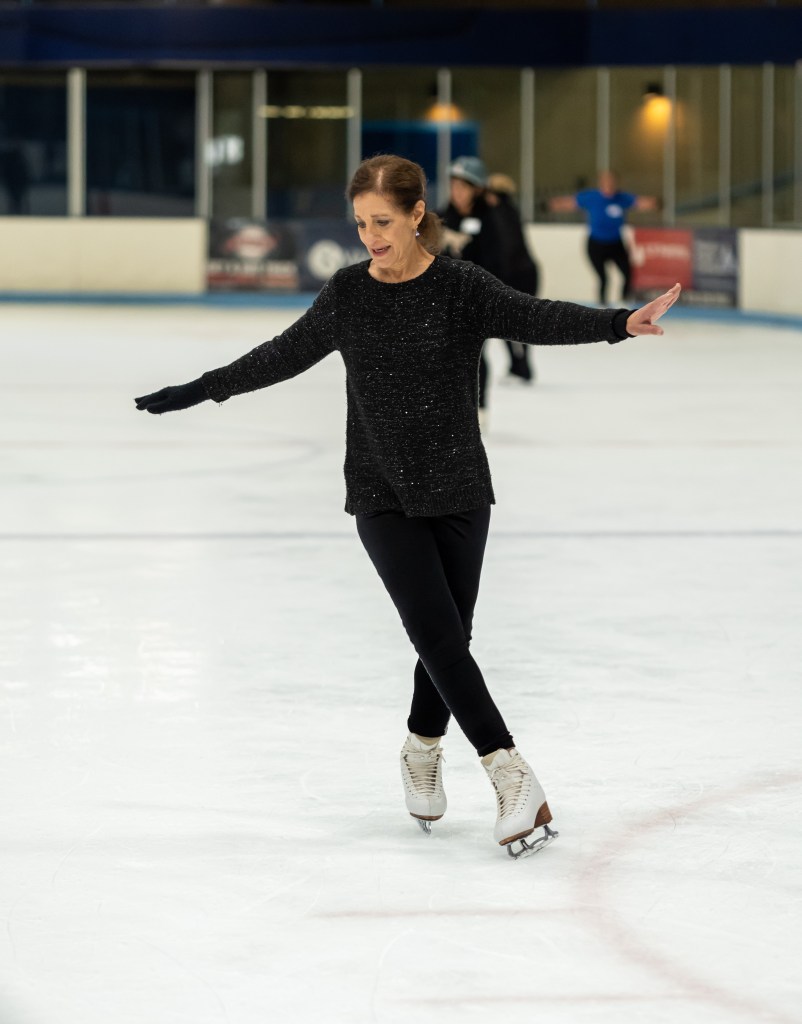
My key takeaway from the class was fascinatingly not about specific turns and steps, but rather the use of the arms to complete and add finishing touches to a choreographic sequence. As the coach put it, “an arm isn’t just an arm.” The arms aren’t simply attached to the body and along for the ride, but rather add depth, dimension, and character to the steps being skated. He encouraged us to include arm movements at key points in the sequence.


And a depiction of the sequence, from start to finish…




Prior to attending Eddie Shipstad’s Single Loop & Loop Combinations class I felt like I my loop jump was in a rut, that my confidence to perform the jump had regressed over the past five years. Shipstad helped me find my confidence once again, providing invaluable guidance that made the jump more accessible both physically and mentally. There were several takeaways for me from Shipstad’s class.
First, Shipstad pointed out a common mistake skaters make with the arms during jump takeoff. Skaters often begin bringing the arms in as they start bending the knees before taking off from the ice. Instead, skaters should wait to bring the arms in until the moment they leave the ice. Bringing the arms in and and taking off from the ice should occur simultaneously.
Another common error (and one that Shipstad pointed out to me that I was making) is with the position of the free leg during jump takeoff and the jump itself. That is, skaters often simply lift the free leg up off the ice without also bringing it in and across the takeoff leg. Shipstad shared a couple tips for preventing this mistake. He recommended that when gliding backward into the jump, if the right leg is your takeoff and landing leg, before leaving the ice lean a little to the right and bring the left foot across and a little bit to the right of the right foot. That way, 1) the skater is able to find a more secure backward outside edge for jump takeoff, and 2) the left foot is already in position across the takeoff leg; all the skater must do is lift the foot and pull it in during takeoff from the ice. The result is that the jump should pop straight up into the air to a greater height, and the rotation will be quicker. For skaters who take off from the left leg, the above would be the opposite: lean to the left and bring the right foot across and a little bit to the left of the left foot.

I received a great mental boost from Shipstad’s class when I landed a loop jump as the second jump in a combination. Prior to the class, I hadn’t done so since I returned to skating in my forties. Shipstad challenged us to add a single loop jump after another single jump of our choice. He pointed out that we should not feel rushed to complete the loop jump, that one of the beauties of performing the loop as the second jump in a combination is that the skater can wait and collect themselves before taking off from the ice. I did just that, taking the time to set up the jump in the manner Shipstad advised, and I was able to do it! This gave me a huge sense of confidence, as though I had finally begun to overcome a barrier in my mind.
As I wrote in Part 1 of my review, perhaps the camp’s greatest value added was the innovative coaching style. All of the coaches encouraged us to approach our skating from a fresh perspective. It was if they were aware of the skills we were working on at home and built upon those skills in creative ways, taking us in challenging new directions. I found this to be the case in all three of the classes I took from the camp’s star, Gracie Gold.
I must admit I was a little nervous in the days leading up to the camp about taking classes from Gold. I worried I might be so intimidated that I wouldn’t be able to skate my best. This fear vanished right away in the first class I took with her. Gold has a kind, down-to-earth, unbiased, and endearing demeanor that puts class attendees immediately at ease.

When I signed up for Gold’s Spirals & Spiral Sequences class, I assumed the class would focus on fine-tuning the spiral itself, for example, body position and edge quality. However, I was pleasantly surprised when Gold announced we would work on change of edge spirals and catch-foot spirals, both of which are more challenging (and fun!) than simply breaking down the good ol’ spiral we all know and love.
A note: I had trouble hearing Gold at the beginning of the class. I am recounting the first part of the class based on what I thought I heard. If anything I have written is incorrect, please feel free to correct me in the Comments section at the end of the post.
Gold began by sharing that the spiral, like other elements in figure skating, is a little bit of a leap of faith. For example, when the skater is gliding along on the outside edge, the spiral will appear more spectacular the greater the quality and depth of the outside edge. The finishing touch to emphasizing that outside edge – and what makes the spiral transform from a simple skating move into a breathtaking and dramatic element all on its own – is that the skater lean the body as much in the direction of the outside edge as possible. Of course, one could always fall out of the spiral by leaning too much, hence the leap of faith.

We then practiced forward change of edge spirals, first from an inside edge to an outside edge, and then from an outside edge to an inside edge. I, like many other class attendees, found the inside-to-outside-edge spiral the easier of the two.
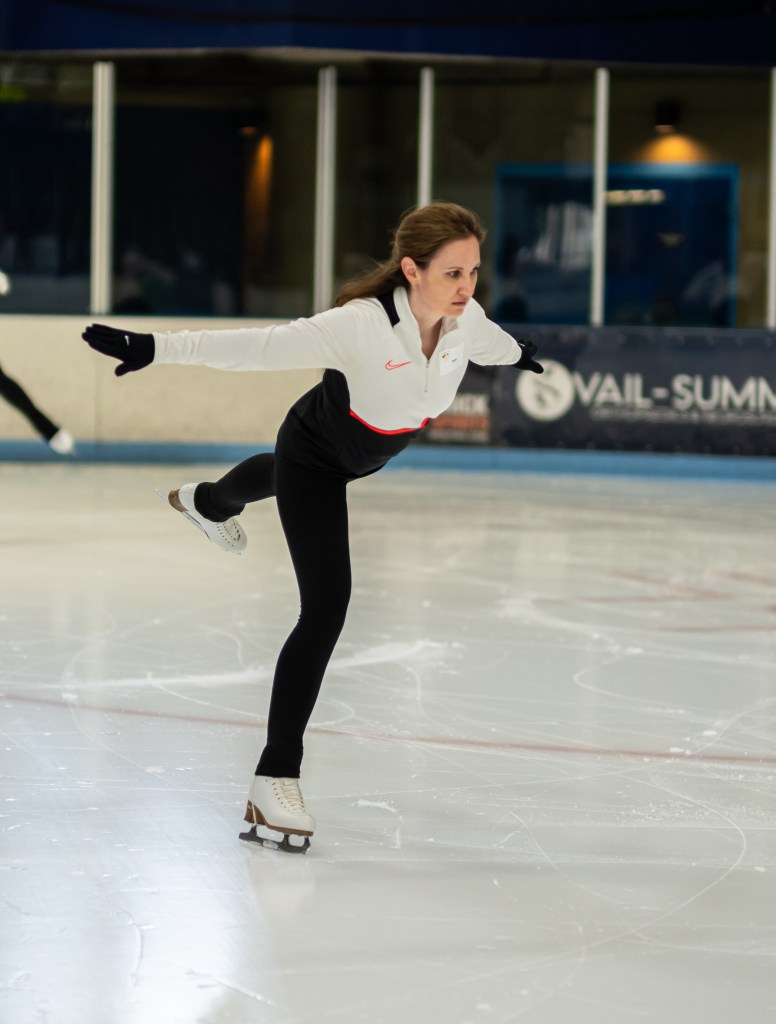

Gold shared a helpful way to gauge if the change of edge is not occurring quickly enough. When the skater hangs out for too long in that sort of purgatory between the two distinct inside and outside edges, the blade drags across the ice, creating an unpleasant scratching sound. Indeed, I heard this sound as I executed the edge change on my spirals.

One nice touch during the class was that Gold spent one-on-one time with attendees.

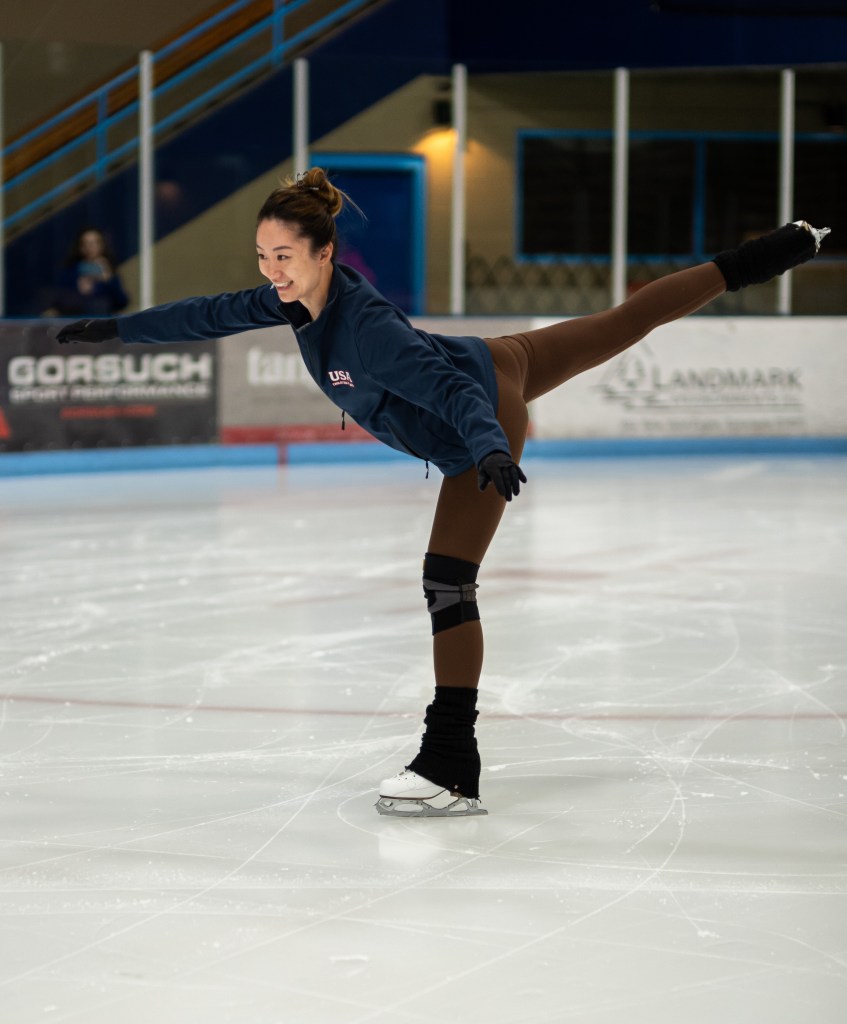
I was fortunate to receive one-on-one attention from Gold during the part of the class focused on catch-foot spirals. She shared that when performing a catch-foot spiral, it is key to focus more on squeezing the hip of the free leg and pushing it upwards, and less on pulling the free leg up with the hand and arm, a common mistake. The end result is more secure and dramatic extension of the free leg.
If the Spirals & Spiral Sequences class was the most favorite class I took with Gracie Gold, her Camel & Sit Spins class was the second favorite. And, just like the Spirals & Spiral Sequences class, it surpassed my expectations in a positive and challenging way. Rather than spending time on the basic spins themselves, the class was focused on spin variations. We warmed up by practicing the basic spins (going forward only; we did not practice backward spins), and then spent the bulk of the class on variations to those spins. While the class was to include the camel spin, other than during the warm-up, we spent almost all of the time on a variation to the sit spin. But this was fine! There is no harm in adjusting on the fly, and we only had so much time. After all, if the group appears to be enjoying one element and is learning a lot, why not stick to it?
A note: I was unable to find ideal photos of the Camel & Sit Spins class so regret not having any to share.
I had just begun practicing the “broken leg” sit spin variation a few weeks prior to the camp, so Gold’s focus was particularly timely in my case. She shared valuable insight on proper spin position. I explain that insight from the perspective of a skater who spins counter-clockwise. Once the skater is in the seated position, Gold said that while turning out the free leg in the broken position toward the right (the leg is bent at the knee with the thigh and lower leg creating an almost ninety-degree angle), it is key to twist the upper body and the arms in the opposite direction toward the left and across the skating leg. The head is turned toward the left as well, with the finishing touch an upward gaze. All of these details combine to create a stable balance with the free leg, which is turned out in the opposite direction.
The most challenging class I took with Gracie Gold was her Single Flip & Lutz class. The flip and lutz have been my most difficult jumps since I returned to skating as an adult. Gold commenced the class by having us practice the loop jump. This allowed her to gauge where attendees were in terms of jump position. She noticed that almost all of us were simply lifting our free leg up upon jump takeoff, as opposed to bringing it up, in, and across the takeoff leg. Thus, she spent a little time demonstrating proper jump position. As a side note, later in the day I experienced a moment of serendipity in Eddie Shipstad’s Single Loop & Loop Combinations class when he shared some of the same guidance as Gold. It is reassuring when coaches independently and unknowingly reinforce one another!

Following the jump position discussion, Gold challenged us to think creatively when skating into the lutz jump. Oftentimes, skaters simply glide into the lutz’s requisite backward outside edge prior to jump takeoff from the toe of the opposite leg. Gold suggested adding choreographic interest and challenge by skating into the lutz from backward cross strokes. One of the goals of backward cross strokes is to find and achieve a strong backward outside edge, making backward cross strokes logical preparatory steps for the lutz. Not only is the repetition of the backward outside edge sequentially pretty, it helps the skater anticipate and prepare for the identical edge needed for a successful lutz jump takeoff. Further, the cross strokes provide greater power for the jump entry than simply gliding into the jump. First we practiced a backward cross stroke drill, and then we practiced a sequence consisting of two backward cross strokes followed by a lutz.

I did not have the opportunity to take any classes with Geoffry Varner, but hope to do so if he returns to the camp in 2024. He led some of the most challenging classes at the camp, including double jumps and combination spins. If you took one of Varner’s classes, please feel free to comment on your experience in the Comments section below.

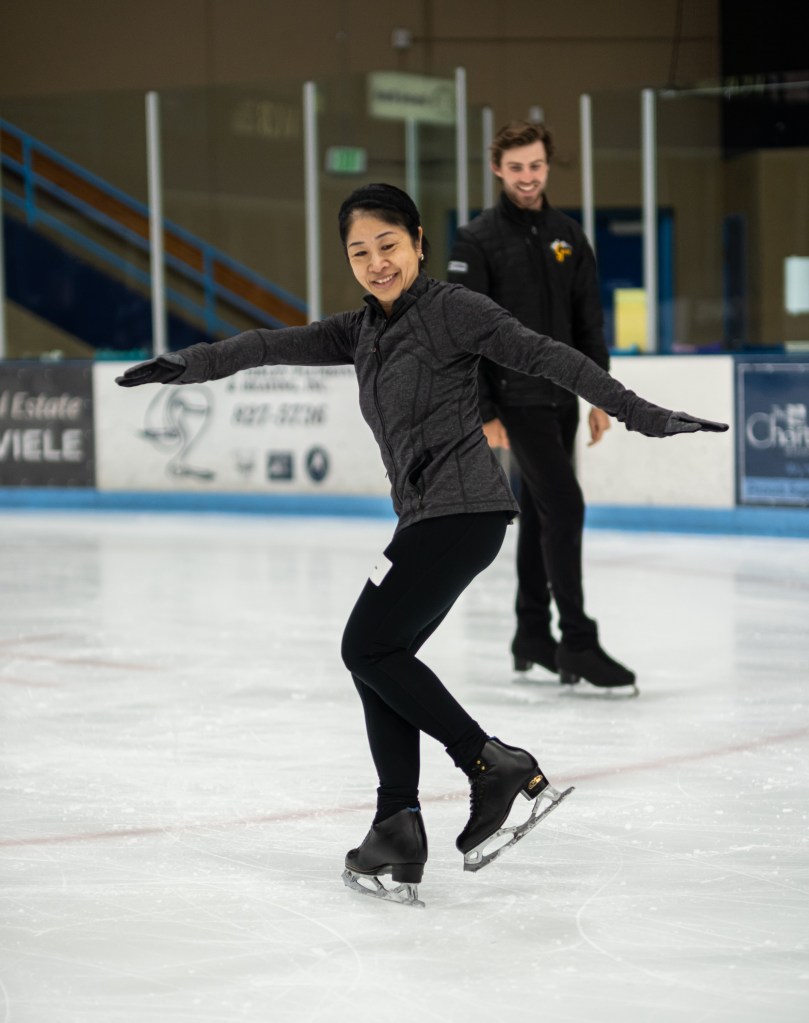
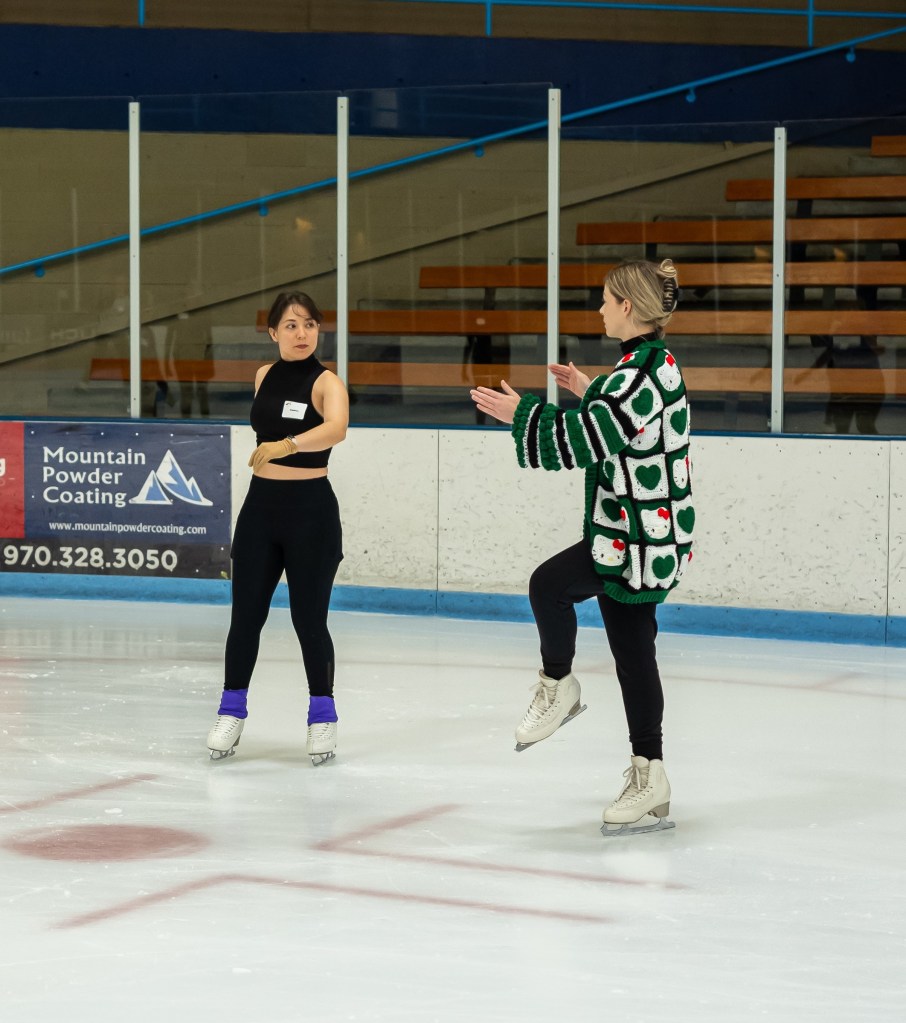
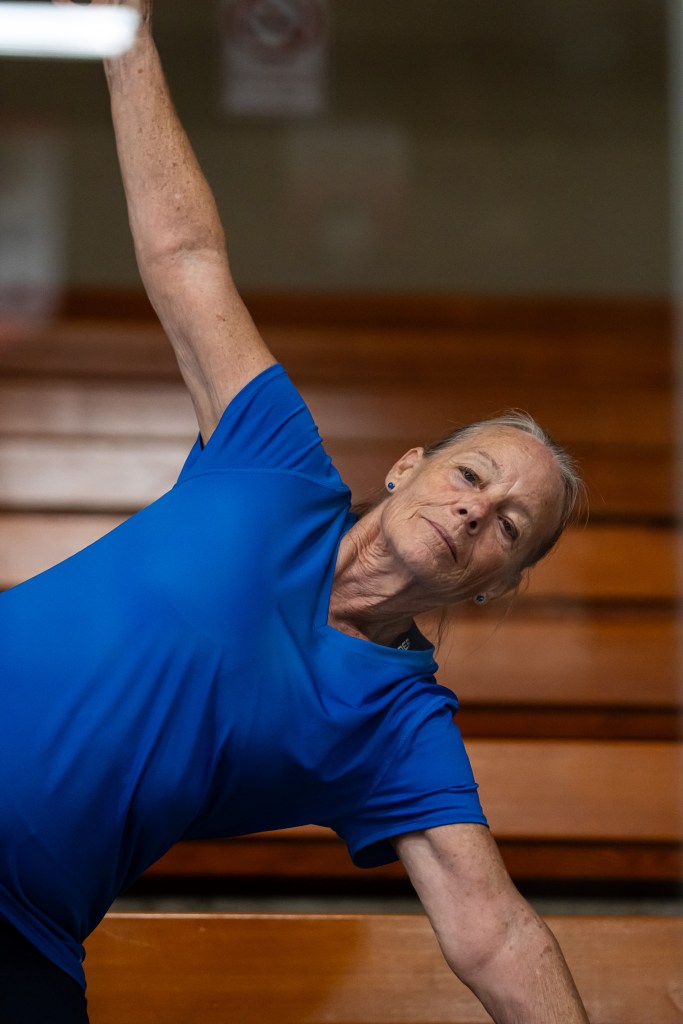
I will close Part 2 of my review the same way I closed Part 1, with a fun collage of photos. As I wrote in Part 1, I was truly amazed by the breadth and depth of talent of the camp attendees. And while there were certainly some advanced skaters at the camp, beginning and intermediate skaters should not be intimidated nor hesitate to attend. Destination Vail provides a range of instruction in an unbiased, supportive environment for adult figure skaters of all levels.








If you’ve enjoyed what you’ve read, subscribe to my blog by entering your email address below. It is an honor to share my experiences with you!
 Finding Balance on the Edge: Figure Skating & Travel Journeys by Carolyn Tir
I couldn’t help but laugh about the comment about how “an arm isn’t just an arm”. I used to take adult ballet classes for a few years and this was something we used to deal with as well. There’s so much focus on the feet work, but the arms are equally just as important, even if they aren’t doing anything crazy. It sounds like you learned a lot from these classes and glad to hear that you got a bit more confidence as well!
LikeLiked by 1 person
Thank you so much for your comment! I’m thrilled that you experienced this in your ballet classes as well! The arms help complete the choreography, for sure. Without those finishing touches, skaters look as though they’re just skating from one element to another.
LikeLiked by 1 person
Wow, this is so amazing and inspiring. I grew up in Latvia where skating during the cold winters was what we did as kids and as adults, but I haven’t been on the skates since I moved to Ireland two decades ago. Just by looking at your photos, I am itching to go back as I loved gliding along the ice and I loved feeling uplifted at the end of my skate session! Thanks for sharing, and have a wonderful day 🙂 Aiva xx
LikeLiked by 1 person
Thank you so much for your kind comment! I’m happy you’ve experienced the exhilarating feeling of gliding on the ice. It is indeed uplifting and brightens my mood every time I do it. I hope one day you’ll be able to find a place to skate in Ireland!
LikeLiked by 1 person
I hope so, too. Or else I have to travel someplace with an ice rink, even if it’s just at a Christmas Market 🤣🤣
LikeLiked by 1 person
Skating at a Christmas Market sounds divine! I’d love to do that someday ⛸️
LikeLiked by 1 person
🥰🥰🥰
LikeLike
When is the camp this year? You must be itching to go again and practise your skills.
LikeLiked by 2 people
Thanks for your comment! This year’s camp was back in July. I was fortunate to be able to go again. I’m planning to post about it soon. I learned a lot, including that I’ve been doing one of my jumps incorrectly! It sure is humbling.
LikeLike
At least you could jump! X
LikeLiked by 1 person
Excellent point!👍⛸️
LikeLike