
One of the most memorable times in my life to date was living in Zagreb, Croatia for six months while my husband and I pursued research projects in the Croatian capital. It was also a cherished opportunity to reconnect with family in the country. We were fortunate to live in Zagreb’s city center in an apartment on Makančeva Ulica, a quiet residential street within walking distance of the main square and on two tram lines. In this post, I relive that memorable time through the lens of the Thursday Doors* weekly photo challenge.
Image featured above: Street sign on Makančeva Ulica. “Ulica” is Croatian for “street,” pronounced oo-lee-tzuh in English.
Croatian language tip: The Croatian language has several consonants with a diacritical mark above them in the shape of a “v.” A useful tip for pronouncing these in English is to remove the mark and add an “h.” For example, the “č” in Makančeva is pronounced like “ch” in English… Makancheva!
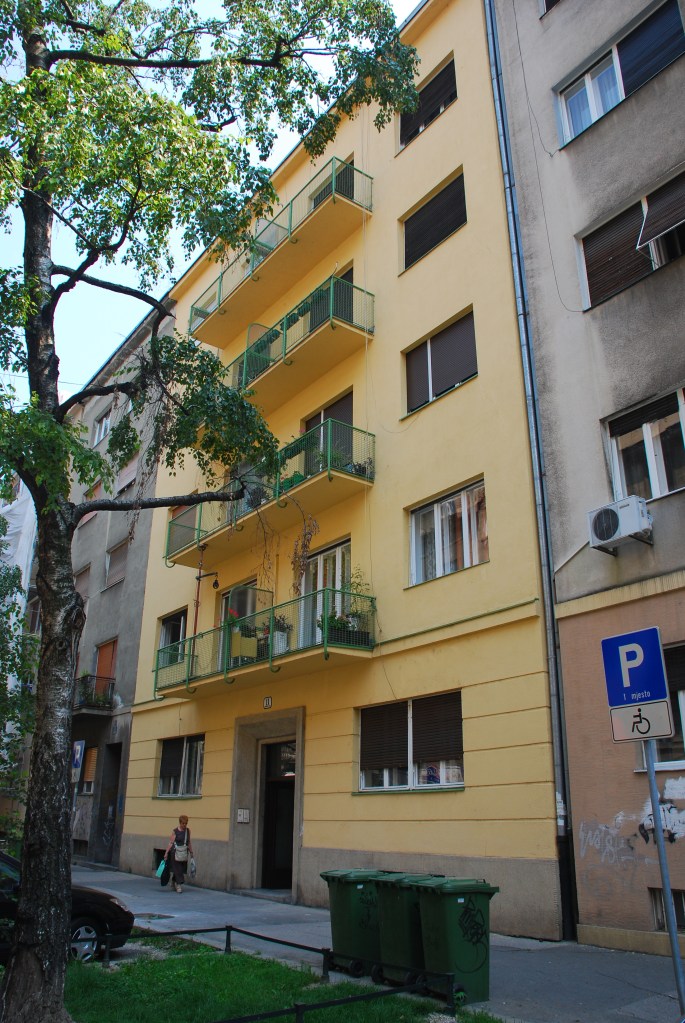
Our building and neighborhood were constructed between the two world wars – a time referred to as the Interwar period – in the Bauhaus-inspired architectural style popular in Europe at that time. The Bauhaus style originated in Germany, with the term Bauhaus derived from the German word “hausbau,” or “building of a house.” In keeping with the elementary German meaning, Bauhaus architecture is minimalist in nature with a focus on functionality. Little to no ornamental and decorative elements are present, with clean lines and basic geometric shapes, often rectangles, emerging as distinctive design elements all on their own.
My husband and I arrived in Zagreb on a cold, dank, and dreary February day. I must admit, when we pulled up to our building on Makančeva Ulica for the very first time, I was wondering just what had we gotten ourselves into! The building’s facade appeared worn and a bit dirty. Buildings inspired by the Bauhaus style do not accommodate dirt and grime well as there is no ornamentation to detract from it. And grey skies are not complementary!
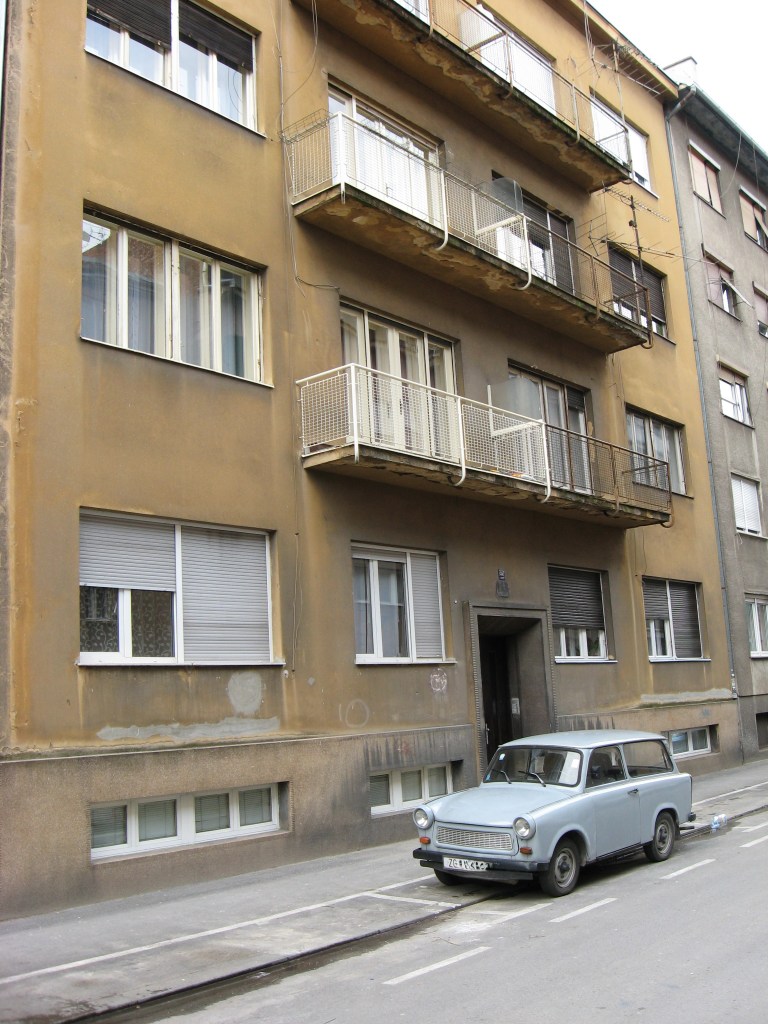
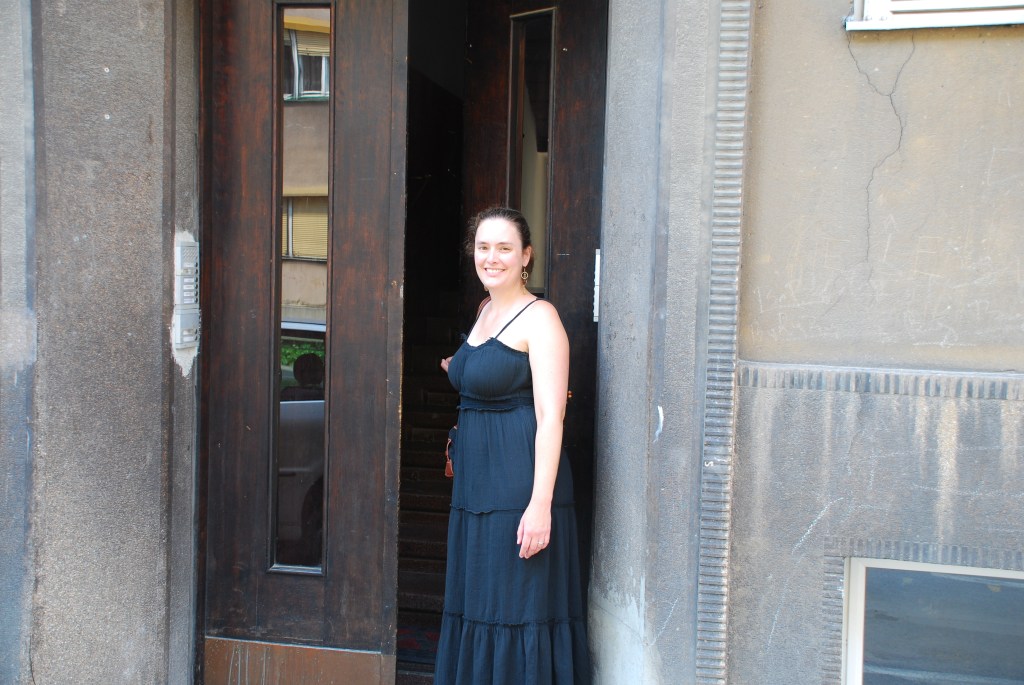
However, after taking that initial tentative step through the front door, my fears were allayed a bit. While outside the building needed a bit of work, inside our apartment was renovated and modern. This is often the case with buildings and apartments in Zagreb. It can be challenging to arrange funds for exterior maintenance, the responsibility of which rests with building residents. Not everyone may be willing or able to participate.
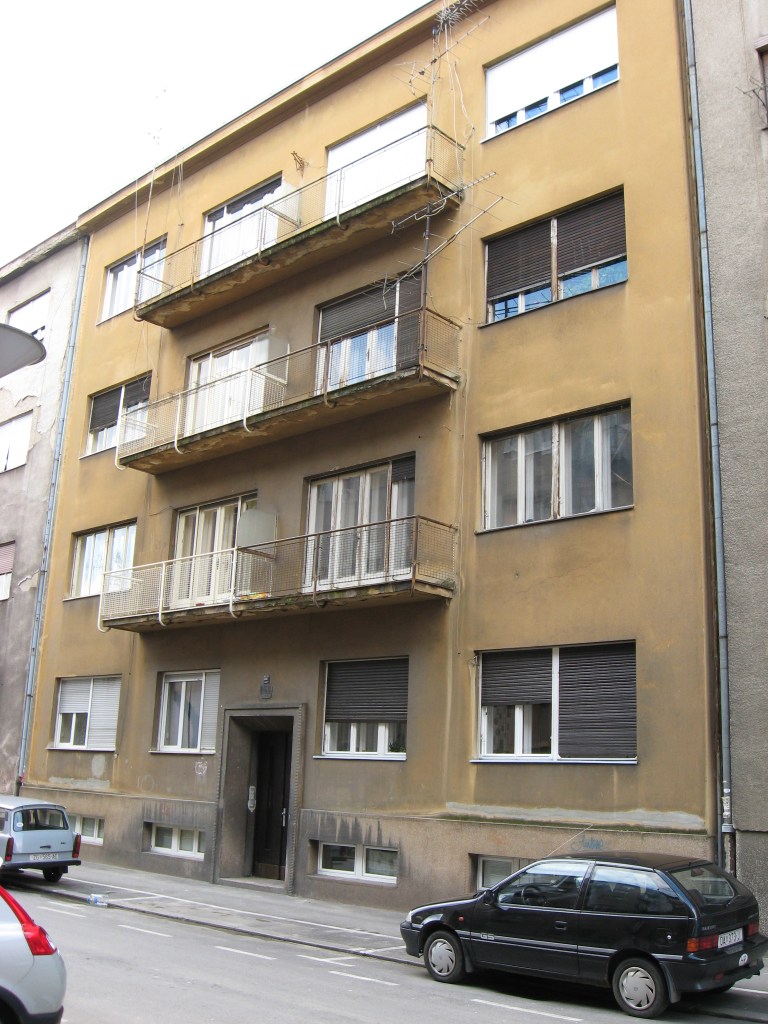
Due to the Bauhaus focus on functionality – a purpose useful and accessible to many – buildings inspired by this style were mass produced. In fact, in my wanderings around the neighborhood, I stumbled upon a building on a nearby street that was almost an exact replica of the building on Makančeva Ulica.
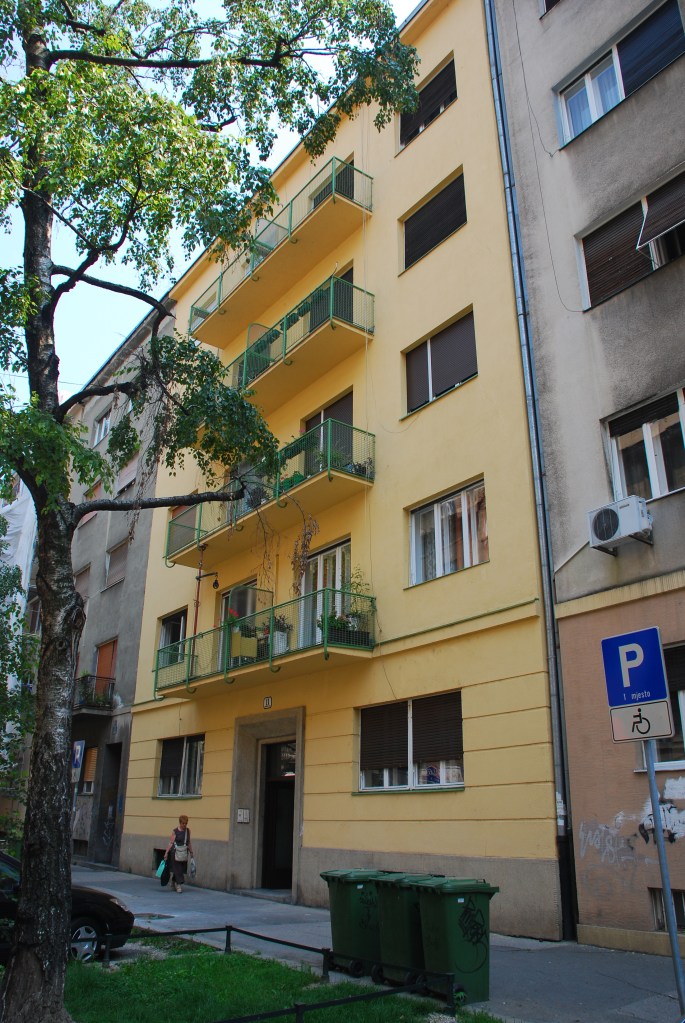
For added perspective, below are the two buildings side by side. A little maintenance makes a big difference!
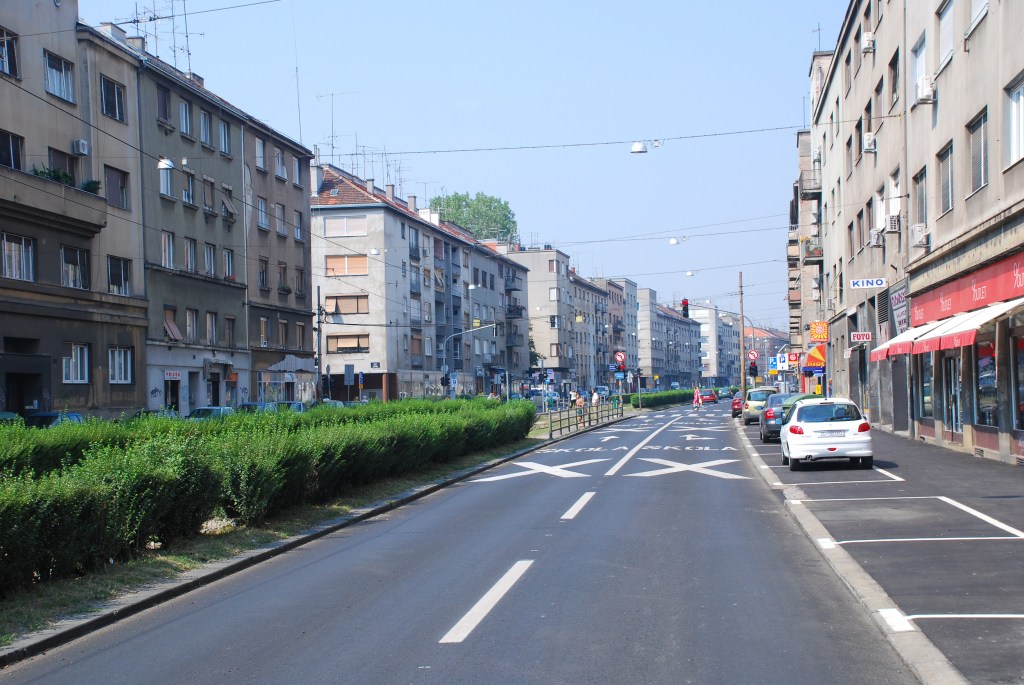
Makančeva Ulica is bounded on the south by Ulica Kralja Zvonimira, or King Zvonimir’s Street. The street is one of the main thoroughfares in the neighborhood. In contrast to quiet residential streets, the buildings on King Zvonimir’s Street have shops and businesses on the ground floor, with private residences above. Like on Makančeva, the Bauhaus-inspired architectural style is prominent throughout.
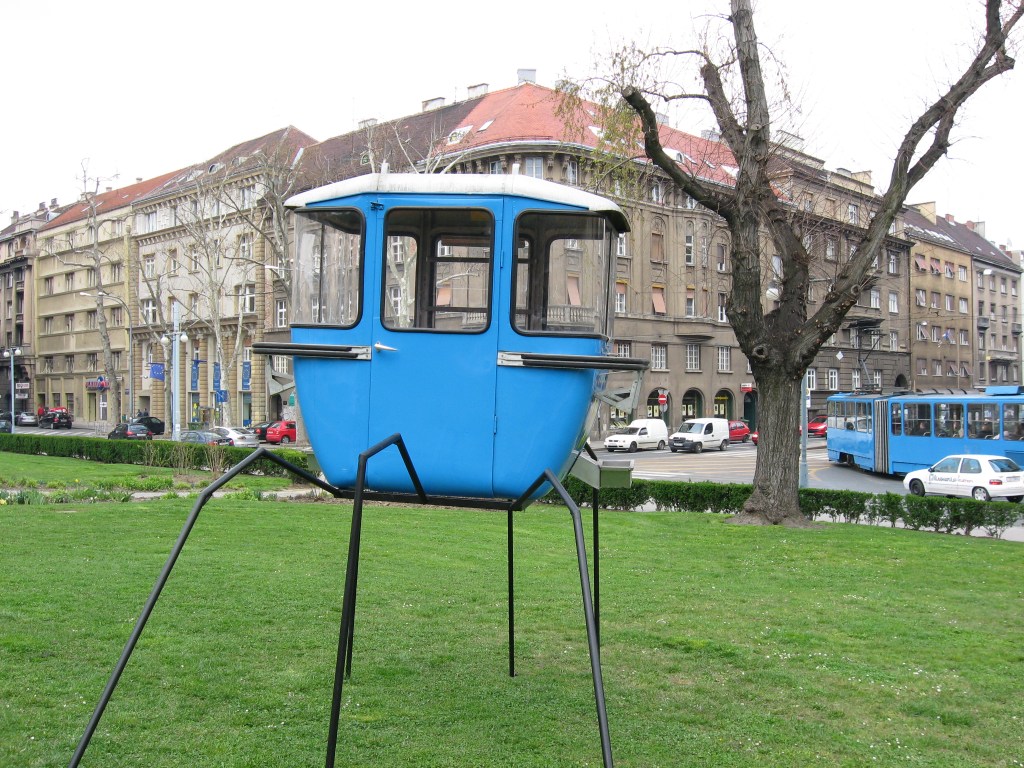
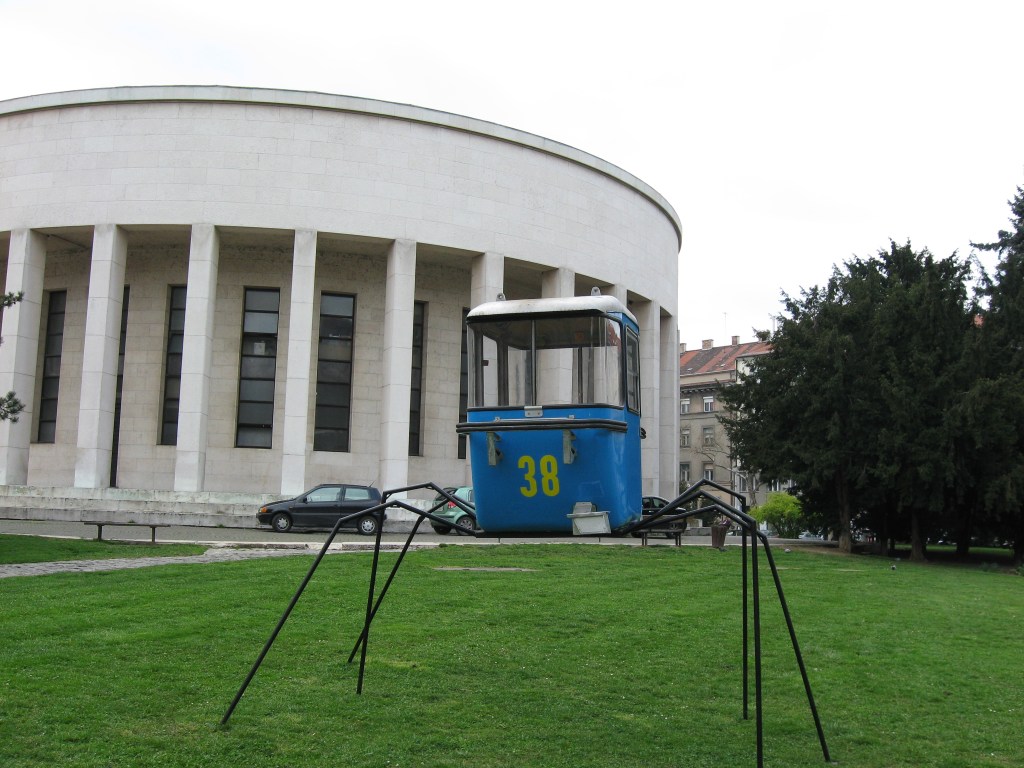
The west end of King Zvonimir’s Street culminates in one of Zagreb’s more unique squares, Trg Žrtava Fašizma, or Victims of Fascism Square. Featured on this square was a quirky art installation made up of a retired gondola car from the Sljeme Peak žičara (ski lift) on Medvednica Mountain behind Zagreb. The car includes a retro-looking door, dating back to when the lift opened in 1963! The lift closed in 2007 to make way for the construction of a modern state-of-the-art version, which made its first trip up the mountain in 2022.
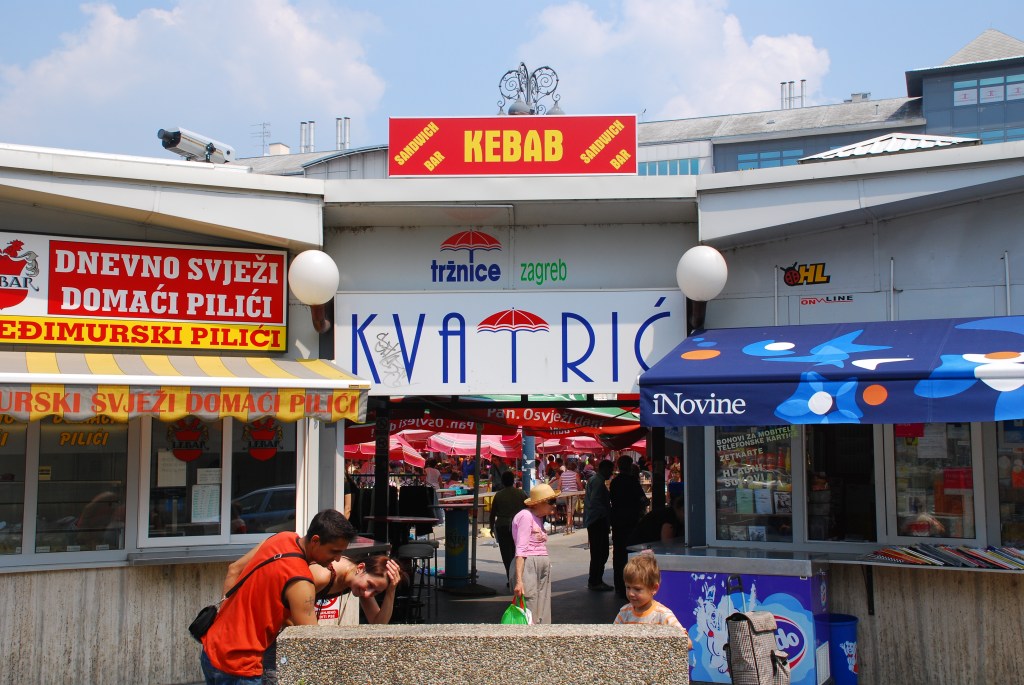
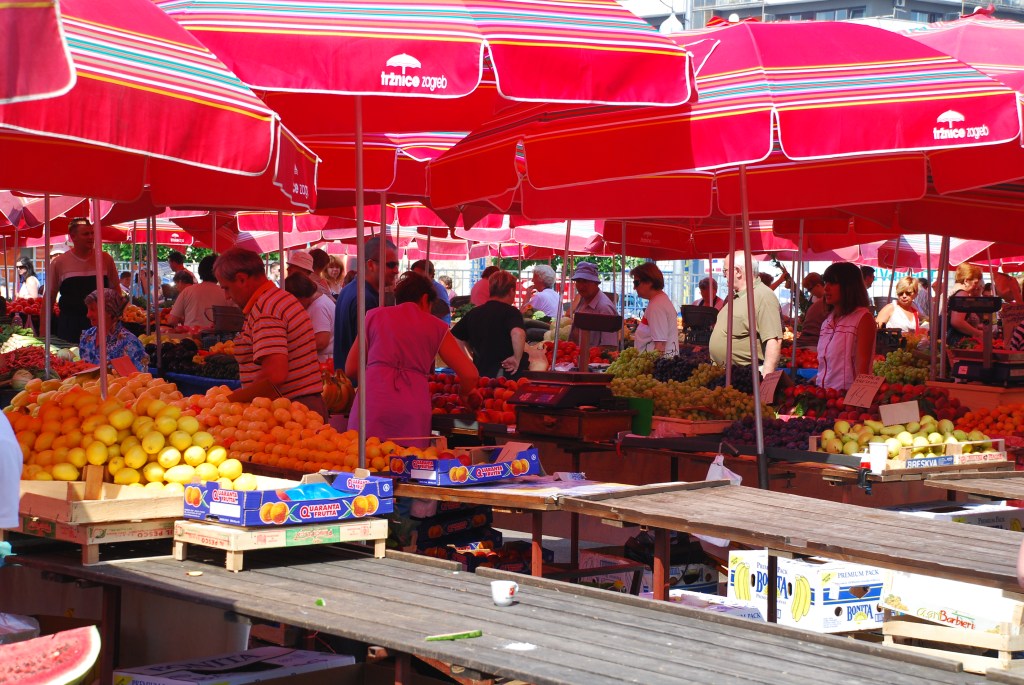
A five minute walk to the northwest of Makančeva Ulica is Kvatrić Market, whose door – or rather, entrance – I passed through at least every other day. The outdoor market was my favorite destination for fresh lettuce, tomatoes, and green onions.
The vendors at the market were patient with my basic (at best!) Croatian language skills. After I’d been shopping there for three weeks, one of them asked if I was a member of the diplomatic corps. I was so flattered! And while technically I was not a diplomat, we are all diplomats and ambassadors of a sort when we live and travel abroad. For how we conduct ourselves in the country we are in reflects back on the country we are from.
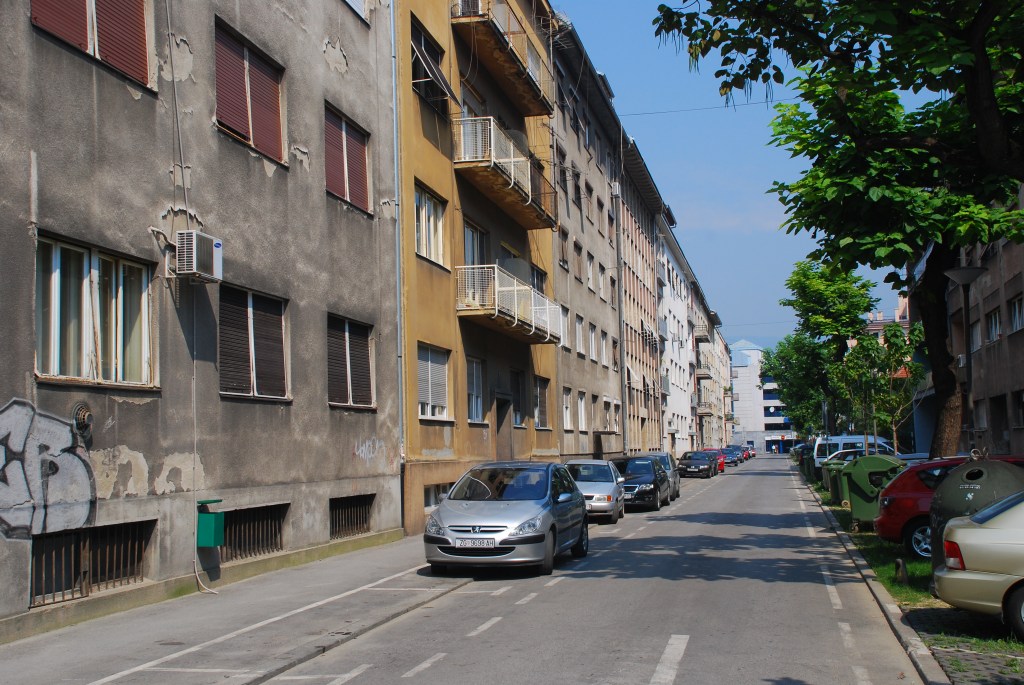
And finally, a photo of Makančeva Ulica in the summer, with a bright blue sky and leafy green trees. Such a contrast from when we arrived in February. Makančeva, I miss you!
*Thursday Doors is a weekly photo challenge hosted by Dan Antion on his blog No Facilities. Dan encourages door and architecture lovers throughout the world to create posts of doors and architecture photographed on their travels. Please visit the following link to learn how to participate: https://nofacilities.com/category/thursday-doors/.
Enjoy what you’ve read? Subscribe to my blog by entering your email address below. It is an honor to share my experiences with you!
 Finding Balance on the Edge: Figure Skating & Travel Journeys by Carolyn Tir
Thanks for sharing a very interesting post. I love learning about other cities and architectural design elements. Of the two buildings, I noticed a different number of panes in the windows and a touch of decoration above the first floor of the building on the right. I little bit goes a long way. I liked the cable car sculpture.
LikeLiked by 1 person
Good eye! The building on the right is also one story higher than the one on the left, and has fewer windows on the ground floor. Thank you so much for stopping by!
LikeLiked by 1 person
An interesting tour. I love the grey car in front of the apartment, and the retired gondola is so full of character.
LikeLiked by 1 person
Indeed! Agreed 100%. Thank you so much for stopping by!
LikeLiked by 1 person
It’s pretty amazing that you were able to live in Croatia for six months and reconnect with family. The minimalist Bauhaus architecture style is interesting. And you’re absolutely right how a bit of colour or maintenance can make a huge difference to an otherwise simple looking building. The gondola car art installation totally looks like a metal spider! It reminds me of the Maman spider sculpture we have outside the National Gallery of Canada in Ottawa.
LikeLiked by 1 person
Wow! I just checked out the Maman spider sculpture. Equally amazing as it is creepy 🤣 Thank you so much for taking the time to stop by! It means a lot.
LikeLiked by 1 person
That Trabant made me smile. In Krakow you could take a tour of Nowa Huta in one. We were recommended to, but never did. The brutalist Soviet style of architecture never appealed much but the inside can be very different. A Polish niece recently bought an old style apartment in Warsawa to remodel. It will be a sound investment. I enjoyed seeing some of Zagreb with you. A talented photographer, Paula, runs a blog called Lost in Translation and lives and works there.
LikeLiked by 1 person
Thank you, Jo, for stopping by! Always great to see you. And thanks for the info about the Lost in Translation blog! I’ll check that out soon. I’m glad the Trabant made you smile. They are sort of charming in their uniqueness. Good luck to your niece with her remodel! I’m sure it will be an adventure and very worth it. I wish I could do the same in Croatia somewhere. Maybe one day!
LikeLiked by 1 person
This is such an interesting post. There are many similar buildings all over Latvia and the Baltic states. The rebirth of independent Latvia gave a new impetus to construction. Initially, the earlier historicist trends were continued. This changed soon and the most productive decade of interwar architecture was heavily influenced by the Art Deco style and the Bauhaus movement. Sadly, it saw a reduction in architectural detail. But while no more bas-reliefs or statues were adorning the facades there were still many large over-arching architectural motives that made the architecture of this period somewhat attractive. Thanks for sharing, and have a good day 🙂 Aiva xx
LikeLiked by 1 person
Thanks, Aiva, for your thoughtful (as always😊) comment! That’s fascinating that you have similar architecture in Latvia and the Baltic states from that time period. I’ve found when I travel around Europe that I see it in many cities. I’ll say to my husband… are we in Zagreb??? Have a wonderful weekend!
LikeLiked by 1 person
🥰🥰🥰
LikeLiked by 1 person
This is an interesting post. I got a kick out of the blue gondola. Thanks for the tour. Hugs.
LikeLiked by 1 person
Thank you so much for stopping by! I agree… the blue gondola is so much fun 😊
LikeLike
Oh, I love the gondola car art and the colorful market shot. I’m very interested in visiting Croatia. Thank you for sharing!
LikeLiked by 1 person
Thank you for stopping by and for your kind comments! Croatia is a fascinating place to visit. The coast is of course always beautiful but Zagreb is wonderful as well, and highly underrated. I hope you can make it to Croatia one day!
LikeLike
You had lots of interesting info in this post. I enjoyed it and now I’m curious if the tenants decorated indoors with the same simplicity. I agree with your statement about how we conduct ourselves. That’s wisdom many could use no matter where they live! Nice post! Sorry I’m so behind.
LikeLiked by 1 person
Thank you so much for taking the time to stop by! No worries on being behind… it sounds like you’ve had a lot on your plate! The apartment I lived in had a sort of simplistic modern aesthetic going on, kind of minimalist yet classy at the same time. So in a way, it did reflect the simplicity of the building’s exterior.
LikeLiked by 1 person
Those buildings remind me so much of my hometown in Italy, with the wooden “blinds” that are rolled down at night (dont know the name in English because they do not exist here!!!!).
Great post!
LikeLiked by 1 person
Thank you so much for stopping by! My husband says the Croatian word for those blinds is “roleta.” It’s amazing how similar the buildings are in Italy. I remember wandering around neighborhoods in Rome and thinking it looked like it could be Zagreb. Thanks again for commenting 😊
LikeLiked by 1 person
lovely memories and an interesting door
LikeLiked by 1 person
Thank you so much for stopping by, Tanja! Lovely memories indeed… a cherished part of my life, to this day.
LikeLiked by 1 person